
The Rise of the Smartphone: A Timeline of Key Milestones in Mobile History
The device that now resides in most of our pockets, a constant companion in our daily lives, has a history far more complex and fascinating than often realized. The smartphone, a seemingly ubiquitous product of the 21st century, is the culmination of decades of technological innovation, ambitious visions, and market shifts. Tracing its lineage reveals a journey from cumbersome early devices to the sleek, powerful portals to the digital world we know today. Understanding this evolution is key to appreciating the profound impact these devices have had on nearly every facet of modern society and to anticipating where this transformative technology might lead us next.
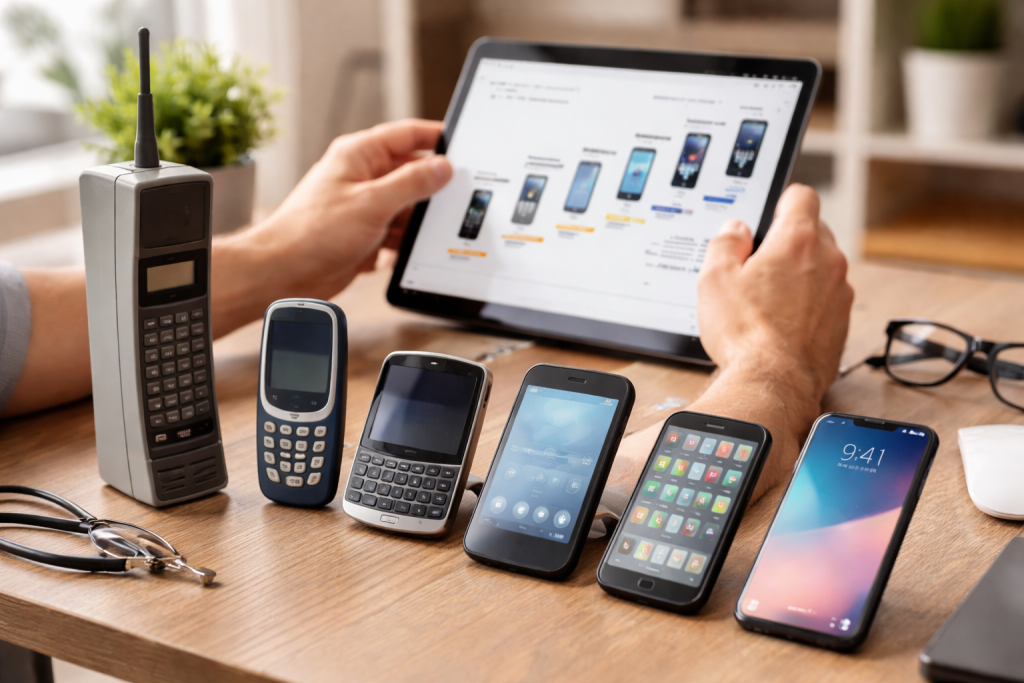
The concept of a portable, connected personal computer was a dream long before it was a reality. Early pioneers envisioned devices that could bridge the gap between communication and computing, laying the groundwork for what would eventually become the smartphone. These initial forays into mobile computing were not always sleek or intuitive, but they represented crucial steps in that direction.
Contents
- 0.1 The Ancestors: PDAs Pave the Way
- 0.2 The First “Smart” Mobile Phones Emerge
- 0.3 The Reign of Symbian and Early Mobile OS
- 0.4 The Arrival of iOS and Android: A Paradigm Shift
- 0.5 A Centralized Hub for Innovation
- 0.6 From WAP to Broadband Speeds
- 0.7 A New Era of Communication and Connection
- 0.8 From Basic Shots to Professional Quality
- 0.9 Accessible Entertainment for the Masses
- 0.10 Bypassing the Wallet
- 0.11 Connecting the Body and the Digital World
- 0.12 What Lies Ahead?
- 1 FAQs
- 1.1 1. What are the key milestones in the history of mobile technology leading to the rise of the smartphone?
- 1.2 2. How did the introduction of app stores change the smartphone landscape?
- 1.3 3. What role has social media played in shaping smartphone usage?
- 1.4 4. How have smartphones transformed the gaming industry?
- 1.5 5. What are the predictions for the next wave of innovation in mobile technology?
The Ancestors: PDAs Pave the Way
Before the term “smartphone” entered common parlance, personal digital assistants (PDAs) were the closest we had to it. Devices like the Psion Organiser, released in the early 1980s, were primarily focused on organizing personal information. Despite their rudimentary interfaces and limited connectivity, they offered features such as calendars, address books, and note-taking capabilities. The Apple Newton, which came out in 1993, was a more ambitious attempt. It had handwriting recognition and an early version of a stylus-based interface. While ultimately not a commercial success, the Newton pushed the boundaries of what was considered possible in a portable computing device. These PDAs, with their focus on personal organization and the nascent idea of digital mobility, were the essential precursors, showcasing the demand for powerful information management in a pocket-sized form factor.
The First “Smart” Mobile Phones Emerge
The late 1990s and early 2000s saw the convergence of mobile phone functionality and PDA capabilities. Companies began to integrate more advanced features into mobile phones, moving beyond basic calling and texting. People often cite IBM’s Simon Personal Communicator, released in 1994, as one of the earliest “smart” phones. It combined a mobile phone with a PDA, featuring a touch screen, a calendar, an address book, a world clock, a calculator, and even the ability to send and receive faxes. While bulky and expensive, it foreshadowed the integrated nature of modern smartphones. Other devices, such as the Nokia Communicator series, also offered email, web browsing (albeit rudimentary), and office applications on a portable device, appealing to business professionals and early adopters. These devices were crucial in demonstrating the viability of combining communication and computing power in a single, portable unit.
The hardware of a mobile device is only as effective as the software that powers it. The evolution of mobile operating systems has been a critical factor in the rise of the smartphone, shaping user experience, dictating device capabilities, and fostering innovation. This evolution has been a dynamic landscape, marked by fierce competition and rapid advancements.
The Reign of Symbian and Early Mobile OS
In the early days of the smartphone era, Symbian OS held a dominant position. Developed by the Symbian Consortium, it powered many of Nokia’s successful smartphones, offering a robust platform for multitasking and third-party applications. Other operating systems like BlackBerry OS, primarily associated with Research In Motion (RIM), focused on enterprise users, excelling in secure email and productivity features. Microsoft’s Windows Mobile also made its mark, attempting to bring a desktop-like experience to mobile devices. While these operating systems laid important groundwork, they often struggled with user-friendliness and a consistent user interface across devices.
The Arrival of iOS and Android: A Paradigm Shift
The introduction of Apple’s iPhone in 2007, powered by its proprietary iOS, marked a watershed moment. iOS introduced a revolutionary touch-based interface, an intuitive user experience, and a focus on elegant design. Google’s Android operating system swiftly followed, providing manufacturers with more flexibility as an open-source platform. The competition between iOS and Android spurred rapid innovation, leading to devices with increasingly sophisticated features, improved user interfaces, and a vast ecosystem of applications. This duopoly has come to define the modern smartphone landscape, driving advancements in performance, functionality, and user engagement.
The advent of application stores transformed the smartphone from a specialized device into a platform for virtually limitless functionality. This innovation democratized software development and empowered users with a personalized, ever-expanding digital toolbox.
A Centralized Hub for Innovation
The launch of Apple’s App Store in 2008, followed closely by Google’s Android Market (now Google Play Store), was a game-changer. Prior to this, obtaining new software for mobile devices was often a cumbersome and fragmented process, involving manual downloads and installations. App stores provided a centralized, secure, and user-friendly marketplace where developers could easily distribute their applications and users could discover and install them with a few taps. This fueled an explosion of creativity, leading to the development of applications for every imaginable purpose, from productivity and entertainment to education and health. The app store model broadened the utility of smartphones and created a massive new economy for software developers.
The ability to access the internet on the go has fundamentally reshaped how we interact with information, communicate, and conduct our lives. The journey from slow, clunky mobile browsing to the instantaneous connectivity of today has been a remarkable technological evolution.
From WAP to Broadband Speeds
Slow connection speeds and limited data capabilities hindered early attempts at mobile internet access. Technologies like WAP (Wireless Application Protocol) provided a simplified way to access a limited subset of internet content. However, it was the widespread adoption of 3G networks that significantly increased the usage of mobile internet. This allowed for faster downloads, more robust web browsing, and the ability to stream media. The subsequent rollout of 4G LTE and now 5G has further accelerated these capabilities, enabling seamless streaming, real-time video conferencing, and a host of data-intensive applications that were previously unimaginable on a mobile device. This continuous improvement in mobile internet infrastructure has been a foundational element in the smartphone’s rise.
The smartphone and social media are intrinsically linked, each fueling the growth and influence of the other. Smartphones’ accessibility and constant connectivity have transformed social media into the primary digital interaction mode for billions.
A New Era of Communication and Connection
Social media platforms like Facebook, Twitter, Instagram, and countless others have become deeply embedded in the smartphone experience. The intuitive interfaces and always-on connectivity of smartphones make it effortless to share updates, photos, and videos and to engage with friends and family in real time. This has fostered new forms of communication, facilitated the formation of online communities, and had a profound impact on everything from personal relationships and news consumption to political discourse and marketing. Smartphones have essentially become the mobile gateways to our social lives, shaping how we connect, share, and perceive the world around us.
The camera has become one of the most important features of modern smartphones, transforming them into indispensable tools for capturing memories and documenting our lives. Remarkable advancements in sensor technology, image processing, and computational photography have characterized this evolution.
From Basic Shots to Professional Quality
Early smartphone cameras were rudimentary, often featuring low-resolution sensors (VGA or even lower) that produced grainy and unremarkable images. However, as smartphone technology has advanced, so too have their cameras. We’ve witnessed a dramatic leap in megapixel counts, the introduction of multiple lenses offering wide-angle and telephoto capabilities, and sophisticated image stabilization. More importantly, computational photography, powered by advanced algorithms and AI, has enabled smartphones to produce stunningly detailed and vibrant photos, often rivaling dedicated cameras. Features like night mode, portrait mode with bokeh effects, and advanced editing tools have made it easier than ever for anyone to capture professional-looking photographs, fundamentally changing how we document our lives.
What began as simple, casual games has evolved into a sophisticated and lucrative mobile gaming industry, all powered by the increasing processing power and graphical capabilities of smartphones.
Accessible Entertainment for the Masses
Smartphones have democratized gaming, making it accessible to a vast audience beyond traditional console or PC gamers. The availability of countless games, from hyper-casual puzzle games to complex role-playing adventures, has turned our phones into portable entertainment hubs. The touch-screen interface, combined with increasingly powerful processors and graphics capabilities, allows for immersive and engaging gameplay. The rise of free-to-play models and in-app purchases has further fueled the industry’s growth, creating a multi-billion dollar market that continues to innovate with augmented reality experiences and cloud gaming. Smartphones have transformed from mere communication devices into powerful gaming consoles that we carry around in our pockets.
The smartphone has significantly transformed our financial transactions, ushering in an era of convenience and digital wallets.
Bypassing the Wallet
The integration of Near Field Communication (NFC) technology into smartphones has enabled contactless payments, allowing users to tap their phones at terminals to complete purchases. This, coupled with the development of secure digital wallet applications like Apple Pay, Google Pay, and Samsung Pay, has made mobile payments a common and increasingly preferred method of transaction for many. These platforms offer a convenient and often more secure alternative to carrying physical credit cards, streamlining the checkout process and further integrating our digital and financial lives. The widespread adoption of mobile payment solutions has significantly accelerated the trend towards a cashless society.
A growing ecosystem of wearable devices seamlessly integrates our digital lives with our physical activities and personal well-being, with smartphones serving as the central hub.
Connecting the Body and the Digital World
Our smartphones increasingly connect to wearable technology, ranging from smartwatches and fitness trackers to wireless earbuds and augmented reality glasses. These devices collect data about our health and activity, provide notifications, and offer new ways to interact with digital content. The smartphone acts as the gateway for syncing this data, managing settings, and accessing advanced features of these wearables. This symbiotic relationship has created new possibilities for personalized health monitoring, fitness tracking, and hands-free interaction with our digital world, extending the reach and utility of the smartphone beyond its physical form.
The relentless pace of innovation in mobile technology shows no signs of slowing down. The smartphone of tomorrow is likely to be even more integral to our lives, with advancements that will redefine our interactions with technology and the world around us.
What Lies Ahead?
Several key trends are likely to shape the future of smartphones. We can anticipate further integration of artificial intelligence, leading to more personalized and predictive user experiences, as well as advancements in battery technology for longer usage. The development of foldable and rollable displays will introduce new form factors, offering greater flexibility and multitasking capabilities. Integration of augmented reality (AR) and virtual reality (VR) will become increasingly prevalent, blurring the boundaries between the physical and digital realms. Furthermore, the ongoing evolution of 6G and beyond will unlock unprecedented speeds and connectivity, paving the way for entirely new applications and services. The smartphone, already a remarkable device, is poised to become even more indispensable, adapting and evolving to meet the ever-changing needs and aspirations of humanity.
FAQs
1. What are the key milestones in the history of mobile technology leading to the rise of the smartphone?
The key milestones in the history of mobile technology leading to the rise of the smartphone include the development of early PDA devices, the introduction of the first iPhone, the evolution of mobile operating systems such as Symbian, iOS, and Android, the impact of app stores, the rise of mobile internet from WAP to 5G, the role of social media platforms, the smartphone camera revolution, the era of mobile gaming, the rise of mobile payments, the influence of wearable technology, and predictions for the future of smartphones.
2. How did the introduction of app stores change the smartphone landscape?
The introduction of app stores changed the smartphone landscape by providing a centralized platform for users to discover, download, and update mobile applications. This led to a significant increase in the availability and diversity of apps, creating new opportunities for developers and businesses. App stores also facilitated the monetization of apps through in-app purchases and advertising, contributing to the growth of the mobile app economy.
Social media platforms have impacted smartphone usage by providing users with a convenient way to connect, share content, and communicate with others. The integration of social media apps into smartphones has transformed how people consume and interact with digital content, leading to changes in communication patterns, media consumption, and online behavior.
4. How have smartphones transformed the gaming industry?
Smartphones have transformed the gaming industry by making gaming more accessible and convenient for a wider audience. The availability of high-quality games on app stores, combined with the increasing processing power and graphics capabilities of smartphones, has led to the rise of mobile gaming as a major segment of the gaming market. Mobile gaming has also driven innovation in game design, monetization models, and multiplayer experiences.
5. What are the predictions for the next wave of innovation in mobile technology?
Predictions for the next wave of innovation in mobile technology include advancements in areas such as 5G connectivity, augmented reality (AR) and virtual reality (VR) experiences, artificial intelligence (AI) integration, improved camera technology, enhanced mobile payment solutions, and the continued integration of smartphones with wearable devices. We expect these innovations to further enhance the capabilities and user experiences of smartphones, thereby shaping the future of mobile technology.

With over 5 years of experience in digital learning and productivity, we specialize in creating practical and easy-to-follow solutions.Our expertise focuses on simplifying complex concepts into clear, actionable strategies for everyday use.We are committed to helping learners and professionals improve efficiency, build skills, and achieve consistent growth.