
Machine Learning 101: Understanding the Basics and Applications
Machine Learning 101: Understanding the Basics and Applications
Fundamentally, machine learning, a transformative field within artificial intelligence, enables systems to learn from data without explicit programming. Instead of relying on rigid, predefined sets of instructions for every possible scenario, machine learning algorithms allow computers to identify patterns, make predictions, and improve their performance over time as they are exposed to more information. This ability to adapt and learn is what makes machine learning so powerful and has led to its widespread adoption across numerous industries. At its core, machine learning is about extracting knowledge and insights from data, much like humans learn from their experiences. The goal is to build models that can generalize from observed data to new, unseen data, allowing them to tackle complex problems and automate tasks that were once deemed impossible for machines. This learning process often involves iterative refinement, where the model adjusts its internal parameters to minimize errors and maximize accuracy.
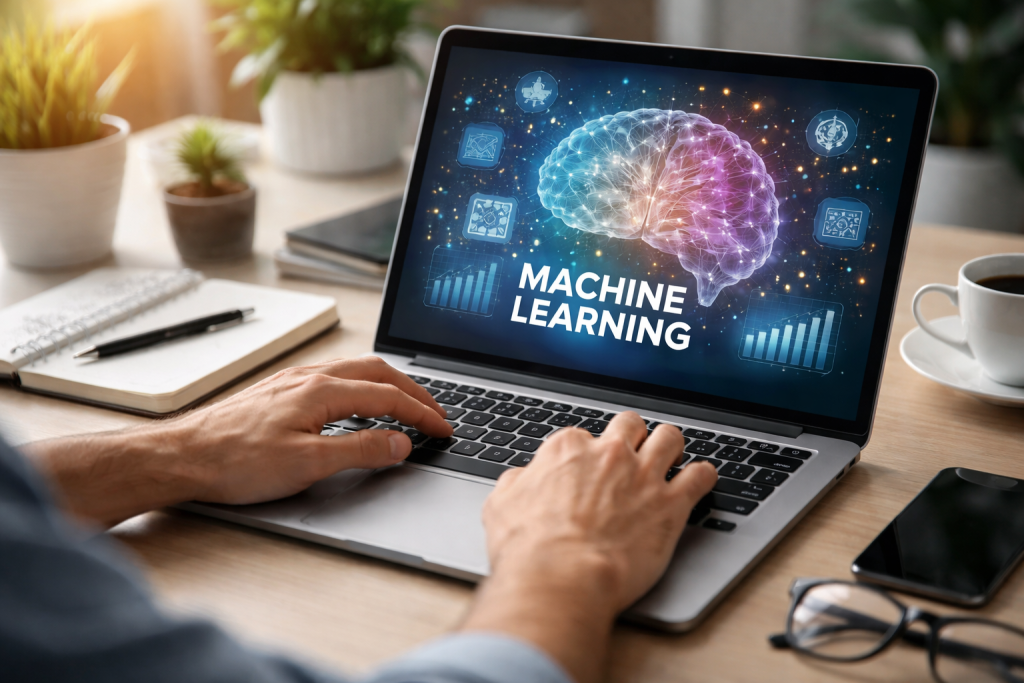
The roots of machine learning can be traced back to the mid-20th century, with early pioneers exploring the idea of machines that could “think” or learn. While the term “machine learning” was coined in 1959 by Arthur Samuel, who developed a checkers-playing program that could learn from its games, earlier concepts of computer learning had already begun to emerge.
Contents
- 0.1 Early Foundations and Inspiration
- 0.2 The Rise of Neural Networks and Statistical Learning
- 0.3 The Big Data Era and Deep Learning Revolution
- 0.4 Supervised Learning
- 0.5 Unsupervised Learning
- 0.6 Reinforcement Learning
- 0.7 Understanding Data
- 0.8 Data Preprocessing
- 0.9 Feature Engineering
- 0.10 Choosing the Right Algorithm
- 0.11 Model Training
- 0.12 Recommendation Systems
- 0.13 Image and Speech Recognition
- 0.14 Fraud Detection and Cybersecurity
- 0.15 Healthcare
- 0.16 Finance
- 0.17 Transportation
- 0.18 Bias in Data and Algorithms
- 0.19 Privacy Concerns
- 0.20 Accountability and Transparency
- 0.21 Advancing Capabilities
- 0.22 Emerging Challenges
- 0.23 Foundational Knowledge
- 0.24 Online Courses and Tutorials
- 0.25 Essential Libraries and Frameworks
- 0.26 Practice and Community
- 1 FAQs
Early Foundations and Inspiration
The early days were characterized by theoretical explorations and the development of foundational algorithms. Researchers were inspired by human cognition and sought to replicate aspects of learning in artificial systems. This period saw the birth of concepts like artificial neural networks, though their computational demands at the time limited their practical application. The focus was on understanding the principles of learning and developing algorithms that could, in a rudimentary way, adapt to new information.
The Rise of Neural Networks and Statistical Learning
The 1980s and 1990s witnessed a resurgence of interest in neural networks, fueled by advancements in computing power and new learning algorithms like backpropagation. This era also saw the growing prominence of statistical learning methods, which provided a more robust mathematical framework for understanding and building learning models. Techniques like support vector machines and decision trees gained traction, offering powerful tools for classification and regression tasks.
The Big Data Era and Deep Learning Revolution
The emergence of the internet and the surge of digital data in the 21st century significantly transformed the field of machine learning. Massive datasets and further improvements in computational resources (particularly GPUs) paved the way for the deep learning revolution. Deep learning, a subfield of machine learning that utilizes artificial neural networks with multiple layers (deep neural networks), has achieved state-of-the-art results in areas like image and speech recognition, natural language processing, and more. This period has seen machine learning transition from an academic pursuit to a ubiquitous technology shaping the modern world.
Machine learning algorithms can be broadly categorized into three main types, each with distinct approaches to learning from data: supervised, unsupervised, and reinforcement learning. Understanding these categories is key to comprehending the diverse applications of machine learning.
Supervised Learning
In supervised learning, the algorithm is trained on a labeled dataset. This means that for each data point, there is a corresponding “correct” output or target variable. The goal of the algorithm is to learn a mapping function from the input features to the output labels so that it can accurately predict the output for new, unseen data. Think of it like a student learning with a teacher providing answers.
Classification
Classification is a type of supervised learning where the goal is to assign data points to discrete categories or classes. For example, a system that identifies whether an email is spam or not spam is performing a classification task. The algorithm learns from emails that have already been labeled as spam or not spam.
Regression
Regression is another form of supervised learning, used when the target variable is continuous. Instead of predicting a category, the algorithm predicts a numerical value. An example is predicting the price of a house based on its features like size, location, and number of bedrooms. The model learns from historical housing data with known prices.
Unsupervised Learning
Unsupervised learning, in contrast, deals with unlabeled data. The algorithm is given a dataset without any predefined output labels. Its task is to find patterns, structures, or relationships within the data itself. This is akin to a detective trying to find clues and connections in a crime scene without being told who the culprit is.
Clustering
Clustering algorithms group data points into clusters based on their similarity. Data points within the same cluster are more similar to each other than those in other clusters. Such algorithms can be used for customer segmentation, anomaly detection, or organizing large datasets. For instance, an e-commerce company might use clustering to group customers with similar purchasing behaviors.
Dimensionality Reduction
Dimensionality reduction techniques aim to reduce the number of features or variables in a dataset while preserving as much of the important information as possible. This is useful for simplifying complex data, improving the performance of other machine learning algorithms, and visualizing high-dimensional data. Principal Component Analysis (PCA) is a common technique in this area.
Reinforcement Learning
Reinforcement learning is a type of machine learning where an agent learns to make a sequence of decisions by trial and error in an environment. The agent receives rewards for desirable actions and penalties for undesirable ones, and its objective is to maximize its cumulative reward over time. This process is how humans and animals often learn.
Agents and Environments
In reinforcement learning, there’s an “agent” that interacts with an “environment.” The agent takes “actions” within the environment, and the environment transitions to a new “state” and provides a “reward” (or penalty) to the agent. The agent’s learning process is driven by this feedback loop.
Learning Through Interaction
The agent doesn’t get explicit instructions on what to do. Instead, it learns a policy, which is a strategy for choosing actions in different states, by exploring the environment and observing the consequences of its actions. This strategy is often used in robotics, game playing (like AlphaGo), and autonomous systems.
The success of any machine learning model hinges critically on the quality and relevance of the data it is trained on and the way those data are prepared. Data and feature engineering are foundational steps that significantly impact a model’s performance and interpretability.
Understanding Data
Data for machine learning can come in various forms, from structured tables with rows and columns to unstructured text, images, and audio. Understanding the nature of the data, its sources, and its potential biases is the first step. Raw data is rarely ready for direct use by algorithms; it often requires cleaning, transformation, and organization.
Data Preprocessing
Before any learning can occur, data needs to be cleaned and prepared. This involves handling missing values, dealing with outliers, and correcting inconsistencies. For example, if a dataset contains ages, and some entries are recorded as “N/A” or negative numbers, these need to be addressed.
Feature Engineering
Feature engineering is the process of using domain knowledge to create new features from existing raw data that can improve the performance of machine learning models. This process involves transforming raw data into features that more accurately represent the underlying problem for the learning algorithm. This procedure is often considered one of the most critical steps in the machine learning pipeline.
Creating New Features
This might involve combining existing features (e.g., creating a “BMI” feature from “weight” and “height”), extracting relevant information (e.g., extracting the day of the week from a date), or transforming features to make them more suitable for certain algorithms (e.g., applying logarithmic transformations to skewed data).
Feature Selection
Not all features are equally useful. Feature selection involves identifying and selecting the most relevant features for the task at hand, removing redundant or irrelevant ones. This can help reduce model complexity, improve training speed, and prevent overfitting.
Once the data is prepared, the next step involves choosing appropriate algorithms and training them to learn from the data. This process involves a delicate balance of mathematical principles and practical implementation.
Choosing the Right Algorithm
The choice of algorithm depends heavily on the type of problem being solved (classification, regression, or clustering), the nature of the data, and the desired outcome. There isn’t a single “best” algorithm; rather, different algorithms excel in different scenarios.
Linear Models
Linear regression and logistic regression are fundamental algorithms that establish linear relationships between features and the target variable. They are often simple, understandable, and a good starting point for many problems.
Tree-Based Models
Decision trees, random forests, and gradient boosting machines (like XGBoost and LightGBM) are powerful algorithms that partition the data based on feature values. They are known for their accuracy and ability to handle complex interactions between features.
Neural Networks and Deep Learning
As mentioned earlier, neural networks, especially deep learning models with multiple layers, are capable of learning highly complex patterns from data. They are particularly effective for tasks involving unstructured data like images, text, and audio.
Model Training
Model training is the process by which an algorithm learns from data. This typically involves feeding the prepared data to the algorithm and iteratively adjusting its internal parameters until it can accurately map inputs to outputs or identify underlying patterns.
The Role of Loss Functions
A loss function quantifies how well or poorly a model is performing. During training, the goal is to minimize this loss function, indicating that the model’s predictions are getting closer to the actual values.
Optimization Techniques
Optimization algorithms, such as gradient descent, are used to systematically adjust the model’s parameters to reduce the loss function. This often involves taking small steps in the direction that decreases the loss the most.
Validation and Hyperparameter Tuning
To ensure the model generalizes well to new data, a portion of the data is typically set aside for validation. Hyperparameters, which are settings that control the learning process itself (e.g., the learning rate in gradient descent), are tuned based on performance on this validation set.
Machine learning has moved beyond theoretical discussions and is now an integral part of our daily lives, powering a vast array of applications that we interact with routinely. Its ability to process voluminous data and identify subtle patterns has unlocked capabilities that were once unimaginable.
Recommendation Systems
Platforms like Netflix, Amazon, and Spotify use recommendation systems, perhaps one of the most ubiquitous applications. They analyze user behavior, preferences, and historical interactions to suggest products, movies, music, or content that the user is likely to enjoy. The underlying algorithms learn from collaborative filtering or content-based methods.
Image and Speech Recognition
Machine learning, particularly deep learning, has revolutionized image and speech recognition. Facial recognition systems that unlock our smartphones, self-driving cars that perceive their surroundings, and virtual assistants that understand our spoken commands are all powered by these advancements.
Natural Language Processing (NLP)
NLP allows computers to understand, interpret, and generate human language. This powers applications like language translation, sentiment analysis (determining the emotional tone of text), chatbots, and text summarization. Imagine the ability of a search engine to understand the nuances of your query.
Fraud Detection and Cybersecurity
In the financial sector, machine learning algorithms are invaluable for detecting fraudulent transactions in real time. By analyzing patterns of legitimate transactions, they can flag suspicious activities that deviate from the norm, thus protecting individuals and institutions. Similarly, in cybersecurity, ML helps identify and prevent cyberattacks.
The power that transforms machine learning is evident in its profound impact on various industries, driving innovation, efficiency, and new possibilities. Machine learning’s capacity to scrutinize intricate data and offer practical insights is revolutionizing business operations and service delivery.
Healthcare
The healthcare sector is experiencing a significant revolution thanks to machine learning. From the early detection of diseases through the analysis of medical imaging (like X-rays and MRIs) to the personalization of treatment plans based on a patient’s genetic makeup and medical history, ML is enhancing diagnostic accuracy and improving patient outcomes. ML’s ability to sift through vast amounts of molecular data is also accelerating drug discovery processes.
Finance
In finance, machine learning is employed for a multitude of purposes. Algorithmic trading, where ML models execute trades based on predictive market analysis, is a prime example. Beyond trading, ML assists in credit scoring, risk assessment, fraud detection, and customer service through intelligent chatbots. It enables more accurate financial forecasting and personalized investment advice.
Transportation
The transportation industry is undergoing a paradigm shift, with autonomous vehicles being the most visible manifestation of machine learning’s impact. Beyond self-driving cars, ML is used to optimize traffic flow, predict maintenance needs for vehicles, improve logistics and supply chain management, and enhance public transportation route planning based on real-time demand.
As machine learning systems become more pervasive, it is imperative to address the ethical implications that arise from their development and deployment. These considerations are important for guaranteeing fairness, protecting individuals, and fostering trust in AI technologies.
Bias in Data and Algorithms
Machine learning models learn from the data they are trained on. If this data contains societal biases (e.g., historical discrimination), the model can learn and perpetuate these biases, leading to unfair outcomes. For instance, an AI used for hiring might unfairly discriminate against certain demographic groups if the training data reflects past hiring inequalities.
Privacy Concerns
The extensive data collection required for many machine learning applications raises significant privacy concerns. Protecting sensitive personal information from unauthorized access and misuse is paramount. Techniques like differential privacy are being explored to allow for data analysis without compromising individual privacy.
Accountability and Transparency
Determining who is accountable when a machine learning system makes an error or causes harm is a complex legal and ethical challenge. Some complex models’ “black box” nature can impede transparency and trust by making it challenging to comprehend the reasoning behind a specific decision. Developing explainable AI (XAI) is a key area of research to address this.
The field of machine learning is in a constant state of evolution, with ongoing research pushing the boundaries of what’s possible while also presenting new challenges to overcome. The future promises even more sophisticated capabilities and wider integration into society.
Advancing Capabilities
We can anticipate continued advancements in areas like general artificial intelligence (AGI), where AI systems possess human-level cognitive abilities across a wide range of tasks. Explainable AI (XAI) will become more mature, providing greater transparency in model decision-making. Multimodal learning, which combines information from different types of data (text, images, audio), will also see significant progress. Furthermore, the development of more efficient and less data-hungry algorithms will democratize access to powerful ML tools.
Emerging Challenges
As ML becomes more powerful, so too do the challenges. Ensuring AI safety and alignment with human values will be paramount. Combating adversarial attacks designed to fool ML systems and addressing the potential for job displacement due to automation will require proactive societal and policy responses. The responsible development and deployment of AI, with a focus on ethical guidelines and regulations, will be critical for harnessing its benefits while mitigating its risks.
Embarking on a journey into machine learning can seem daunting, but with the right resources and a structured approach, it’s an accessible and rewarding pursuit. A wealth of information and tools is available to guide aspiring learners.
Foundational Knowledge
For beginners, a solid understanding of mathematics, particularly linear algebra, calculus, and probability, is highly beneficial. Familiarity with programming, especially Python, is essential, as it is the de facto language for machine learning due to its extensive libraries.
Online Courses and Tutorials
Numerous online platforms offer comprehensive courses on machine learning, ranging from introductory overviews to specialized topics. Websites like Coursera, edX, Udacity, and Kaggle provide structured learning paths, often taught by leading experts in the field. These courses typically include lectures, assignments, and hands-on projects.
Essential Libraries and Frameworks
Python’s ecosystem for machine learning is incredibly rich. Libraries like NumPy for numerical operations, Pandas for data manipulation, Scikit-learn for classic ML algorithms, and TensorFlow and PyTorch for deep learning are indispensable tools. Learning to use these libraries effectively is a key step in practical machine learning.
Practice and Community
Kaggle, a platform for data science competitions, offers a fantastic environment to practice skills on real-world datasets, learn from others’ solutions, and engage with the machine learning community. Participating in projects, experimenting with different algorithms, and sharing knowledge are crucial for continuous learning and growth in this dynamic field.
FAQs
What is machine learning?
Machine learning is a subset of artificial intelligence that involves the development of algorithms and statistical models that enable computers to improve their performance on a specific task through experience, without being explicitly programmed.
What are the types of machine learning?
There are three main types of machine learning: supervised learning, unsupervised learning, and reinforcement learning. Supervised learning involves training a model on labeled data, unsupervised learning involves finding patterns in unlabeled data, and reinforcement learning involves training a model to make sequences of decisions.
What are the real-world applications of machine learning?
Machine learning has a wide range of real-world applications, including recommendation systems (e.g., Netflix recommendations), image recognition (e.g., facial recognition), healthcare (e.g., disease diagnosis), finance (e.g., fraud detection), and transportation (e.g., autonomous vehicles).
What is the Impact of Machine Learning in Industries?
Machine learning has had a significant impact on industries such as healthcare (improving patient outcomes), finance (automating processes and detecting fraud), and transportation (advancing autonomous vehicles and optimizing logistics).
What are the ethical considerations in machine learning?
Ethical considerations in machine learning include addressing bias in algorithms, protecting privacy in data collection and usage, and ensuring accountability for the decisions made by machine learning models.

With over 5 years of experience in digital learning and productivity, we specialize in creating practical and easy-to-follow solutions.Our expertise focuses on simplifying complex concepts into clear, actionable strategies for everyday use.We are committed to helping learners and professionals improve efficiency, build skills, and achieve consistent growth.