
Uncovering the Origins of Software: A Journey Through the Early Days of Programming
The digital world we inhabit, a tapestry woven with lines of code and intricate algorithms, didn’t spring into existence fully formed. Its foundations were laid by visionary thinkers and relentless problem-solvers long before the ubiquitous personal computer or the internet became commonplace. This journey takes readers through the nascent stages of software, exploring its origins, the pioneers who shaped it, and the technological leaps that transformed abstract ideas into functional realities.
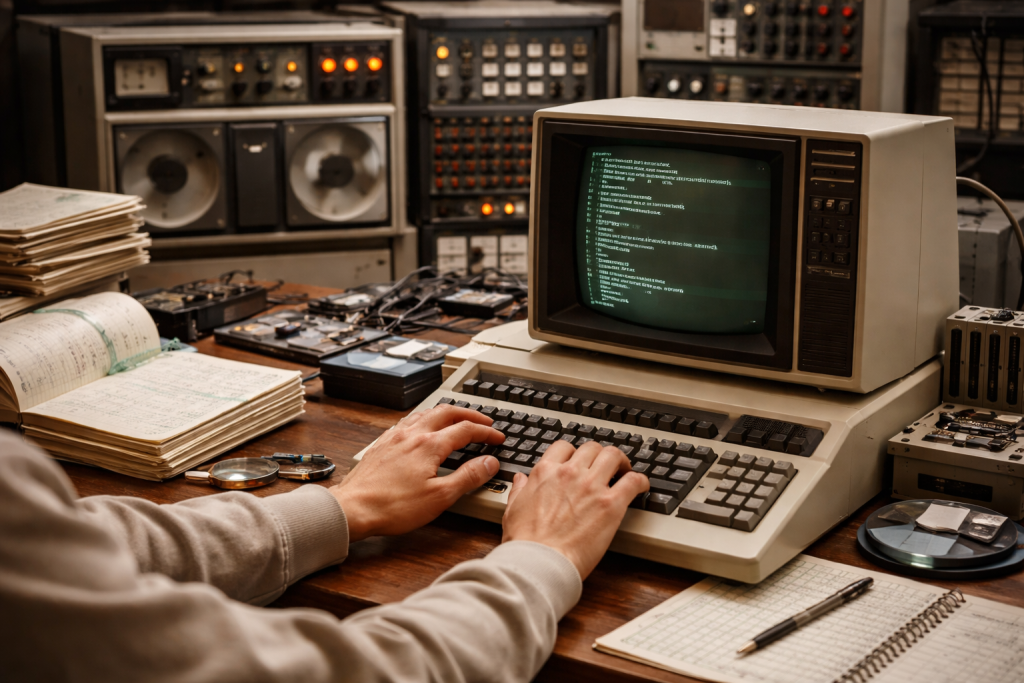
We can trace the very notion of a programmable machine, the foundation of modern software, back to mechanical marvels designed for calculation. These early contraptions, while not “software” in the modern sense, represented crucial conceptual predecessors.
Contents
- 0.1 Charles Babbage and the Analytical Engine
- 0.2 Herman Hollerith and the Tabulating Machine
- 0.3 The ENIAC and its Primitive Programming
- 0.4 The Stored-Program Concept: Von Neumann Architecture
- 0.5 FORTRAN: The First High-Level Language
- 0.6 COBOL: The Language of Business
- 0.7 LISP: The Dawn of Artificial Intelligence and Functional Programming
- 0.8 The Era of Transistors and Integrated Circuits
- 0.9 The Rise of Operating Systems: Managing the Machine
- 0.10 The Foundation for Modern Software Engineering
- 0.11 The Interconnectedness of Early Innovations
- 1 FAQs
- 1.1 1. What were the early programming languages, and how did they evolve?
- 1.2 2. Who were some influential figures in the early days of programming?
- 1.3 3. What role did early computers play in shaping software development?
- 1.4 4. What were some of the challenges and breakthroughs in early software development?
- 1.5 5. How did early software development shape the digital age and modern technology?
Charles Babbage and the Analytical Engine
At the heart of this early evolution lies the visionary work of Charles Babbage in the 19th century. His designs for the Difference Engine and, more significantly, the Analytical Engine, were remarkably prescient. The Analytical Engine was conceived as a general-purpose mechanical computer, capable of performing any mathematical calculation. Its design incorporated key elements that would later become fundamental to computer architecture: an arithmetic logic unit (the “mill”), memory (the “store”), and input/output mechanisms.
Ada Lovelace: The First Programmer
It was through Babbage’s collaboration with Augusta Ada King, Countess of Lovelace, that the concept of programming truly began to take shape. Lovelace, a gifted mathematician, recognized the potential of the Analytical Engine beyond mere arithmetic. In her notes on the engine, she described an algorithm for producing Bernoulli numbers, which is widely considered the first algorithm intended to be processed by a machine. She understood that the engine could manipulate symbols, not just numbers, thus foreshadowing the abstract nature of modern software. Her insightful writings, often overlooked in her time, illuminate the abstract and logical underpinnings of what would become programming.
Herman Hollerith and the Tabulating Machine
Another significant step toward automated data processing came with Herman Hollerith’s tabulating machine, designed for the 1890 US census. This electromechanical device used a system of punch cards to store and process data, dramatically speeding up the census tabulation process. While not programmable in a general sense, Hollerith’s invention demonstrated the power of automated data handling and laid the groundwork for the development of data processing systems, which would later be controlled by software.
The mid-20th century witnessed a seismic shift with the advent of electronic computers, which transformed theoretical concepts into tangible, albeit primitive, computing power. These machines, vastly more complex than their mechanical predecessors, demanded a new way of thinking about instructions and operations.
The ENIAC and its Primitive Programming
The Electronic Numerical Integrator and Computer (ENIAC), completed in 1945, was one of the first general-purpose electronic digital computers. However, its “programming” was a highly manual and laborious process. It involved physically rewiring the machine, setting switches, and plugging in cables to define the sequence of operations. These factors meant that reprogramming could take days or even weeks. Despite its limitations, ENIAC proved the feasibility and immense potential of electronic computation, paving the way for more sophisticated approaches.
The ENIAC Programmers: Unsung Heroines
It is crucial to acknowledge the vital role played by the women who served as ENIAC programmers. Initially trained to operate and set up the machine, figures like Jean Bartik, Betty Holberton, and Marlyn Meltzer developed innovative techniques for configuring the machine and even wrote some of the earliest subroutines. Their meticulous work, often uncredited in historical accounts, was essential to ENIAC’s functionality and represented the very first steps in the art of software development.
The Stored-Program Concept: Von Neumann Architecture
A revolutionary leap forward was the concept of the stored-program computer, largely attributed to John von Neumann. Instead of physically rewiring the machine for each task, the instructions (the program) were stored in the computer’s memory, just like data. This meant that programs could be loaded, modified, and executed electronically, dramatically increasing the speed and flexibility of computation. The Von Neumann architecture, with its central processing unit, memory, and input/output, became the foundational model for most subsequent computer designs.
Early Assembly Languages
With the advent of stored programs, the need for more efficient ways to represent instructions arose. Early programmers worked with machine code, a series of binary digits that the computer could directly understand. This method was incredibly tedious and error-prone. Assembly languages emerged as a symbolic representation of machine code, using mnemonics (short abbreviations) for instructions. This process made programming more readable and manageable, although it still remained very close to the hardware.
The journey from machine code and assembly language to the high-level languages we use today is a testament to the continuous drive for abstraction and user-friendliness in software development. Each generation of languages aimed to make programming more accessible and powerful.
FORTRAN: The First High-Level Language
Developed by John Backus and his team at IBM in the 1950s, FORTRAN (Formula Translation) was a groundbreaking achievement. It was the first widely used high-level programming language, designed primarily for scientific and engineering applications. FORTRAN allowed programmers to write instructions in a more human-readable format, using mathematical expressions and English-like keywords. This version represented a significant departure from assembly language, enabling faster development and making complex computations more manageable.
The Impact of FORTRAN on Scientific Computing
FORTRAN’s introduction democratized scientific computing. Researchers and scientists who were not necessarily computer experts could now leverage the power of computers to solve complex problems. Its efficiency and effectiveness led to its widespread adoption in fields like physics, engineering, and mathematics, contributing to numerous scientific breakthroughs.
COBOL: The Language of Business
In parallel with FORTRAN’s rise, business-oriented programming also began to take shape. COBOL (Common Business-Oriented Language), developed in the late 1950s, was designed for commercial data processing. English heavily influenced its syntax, making it accessible to business professionals. COBOL proved incredibly successful in mainframe environments for tasks like accounting, inventory management, and payroll processing, and its legacy continues to impact legacy systems to this day.
The Enduring Relevance of COBOL
Despite its age, COBOL remains surprisingly relevant in many financial institutions and government agencies. Its robustness and efficiency in handling large-scale business transactions have ensured its continued use in critical legacy systems, highlighting the long-term impact of early programming language design choices.
LISP: The Dawn of Artificial Intelligence and Functional Programming
Developed by John McCarthy in the late 1950s, LISP (List Processing) took a different path. It was designed for symbolic manipulation and became instrumental in early artificial intelligence research. LISP introduced concepts like recursion and functional programming, which have since influenced many modern languages. Its unique syntax, based on S-expressions, allowed for powerful and flexible manipulation of data structures.
Advances in computer hardware inextricably linked the evolution of software. Every new hardware generation created new opportunities for software development, while software demands continuously challenged the capabilities of hardware.
The Era of Transistors and Integrated Circuits
The transition from vacuum tubes to transistors in the 1950s and then to integrated circuits (ICs) in the 1960s was a monumental leap. Transistors were smaller, faster, more reliable, and consumed less power than vacuum tubes. ICs, which contained multiple transistors on a single chip, further miniaturized and increased the computing power of machines. These advancements made computers more accessible, affordable, and ultimately, more integral to society.
The Shrinking Size and Growing Power of Computers
The miniaturization enabled by transistors and ICs was crucial for the development of smaller, more specialized computers. This eventually led to minicomputers and, later, the personal computer revolution, which profoundly changed how people interacted with technology and software.
The Rise of Operating Systems: Managing the Machine
As computers became more complex, the need for a system to manage their resources became paramount. Operating systems emerged as the fundamental software layer that controlled hardware and provided a platform for other applications to run. Early operating systems were rudimentary, but they paved the way for modern OSes like Unix, which introduced concepts like multitasking and multiprogramming, significantly improving computer efficiency.
The Influence of Early Operating Systems on Modern Computing
The design principles and architectural choices made in early operating systems, particularly Unix, continue to influence the design of contemporary operating systems, including Linux and macOS. Concepts like file systems, process management, and user interfaces have a direct lineage to these foundational systems.
The pioneers of early software development laid the groundwork for the digital age while often working with limited resources and facing immense technical hurdles. Their innovations and conceptual breakthroughs continue to shape the technology we use every day.
The Foundation for Modern Software Engineering
The challenges faced by early programmers, such as debugging complex programs and managing limited memory, led to the development of fundamental principles of software engineering. Concepts like modularity, abstraction, and the importance of clear documentation can be traced back to the practical necessities of early software development.
Lessons in Problem-Solving and Persistence
The stories of early programmers are often tales of ingenious problem-solving and unwavering persistence. They tackled problems with limited tools and considerable ingenuity, demonstrating the power of human intellect and creativity in overcoming technological limitations. These are valuable lessons for any aspiring technologist.
The Interconnectedness of Early Innovations
It’s crucial to recognize that early software development wasn’t a series of isolated events. Deep connections existed between the advancements in hardware, programming languages, and operating systems, each of which influenced and enabled the others. A recurring theme in this historical narrative is the iterative nature of innovation, where one breakthrough sparks the next.
The journey from punch cards and intricate wiring to the sophisticated software that powers our lives is a remarkable testament to human ingenuity. Individuals who dared to imagine machines capable of thought, calculation, and ultimately creation laid the foundations of this digital world. Understanding these origins provides not only a historical perspective but also invaluable insights into the ongoing evolution of technology and the enduring principles that guide its development. The legacy of these early innovators will continue to motivate and inform the technological landscape of today and tomorrow.
FAQs
1. What were the early programming languages, and how did they evolve?
The early programming languages included machine code, assembly language, and high-level languages such as FORTRAN and COBOL. These languages evolved to become more user-friendly and efficient, leading to the development of modern programming languages like Python, Java, and C++.
2. Who were some influential figures in the early days of programming?
Influential figures in the early days of programming include Grace Hopper, who developed the first compiler for a programming language, and Ada Lovelace, who is considered the world’s first computer programmer. Other notable pioneers include John Backus, who created FORTRAN, and Dennis Ritchie, who developed the C programming language.
3. What role did early computers play in shaping software development?
Early computers, such as the ENIAC and UNIVAC, had an influential impact on software development by providing a platform for programmers to write and test their code. These early computers also drove the need for more advanced programming languages and techniques to make the most efficient use of their capabilities.
4. What were some of the challenges and breakthroughs in early software development?
Challenges in early software development included limited memory and processing power, as well as the need to write code directly in machine language. Breakthroughs included the development of higher-level programming languages, the invention of the compiler, and the creation of operating systems to manage computer resources more efficiently.
5. How did early software development shape the digital age and modern technology?
By creating the tools and techniques still used in modern technology, early software development laid the foundation for the digital age. Early programming innovations and lessons continue to influence and shape the development of software and technology today.

With over 5 years of experience in digital learning and productivity, we specialize in creating practical and easy-to-follow solutions.Our expertise focuses on simplifying complex concepts into clear, actionable strategies for everyday use.We are committed to helping learners and professionals improve efficiency, build skills, and achieve consistent growth.