
Mastering the Basics of Internet Protocols: Everything You Need to Know
The internet, an elaborate web of interconnected devices, hums with a constant, unseen flow of information. This ceaseless data transmission isn’t magic; it’s the result of a precisely defined set of rules and standards known as internet protocols. These protocols are the silent architects of our digital lives, dictating how devices speak to each other and how data is packaged, routed, and received. Without them, the vastness of the internet would be an incomprehensible jumble of noise. Mastering these fundamentals is not just for network engineers; it’s increasingly essential for anyone seeking to understand the digital landscape they inhabit.
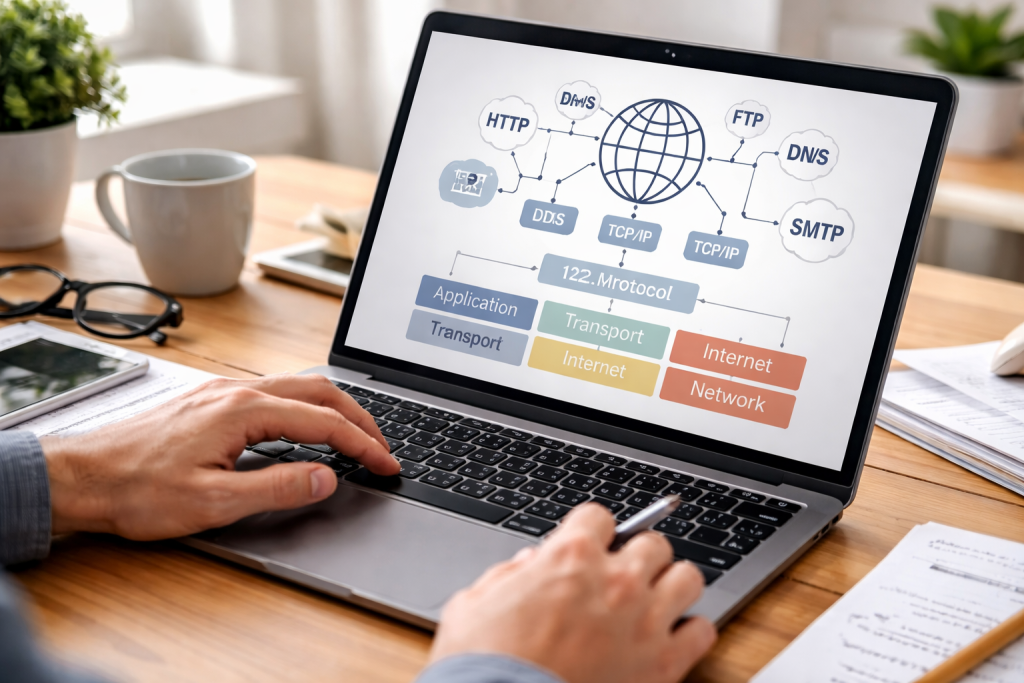
At the heart of the internet’s operation lies the Transmission Control Protocol/Internet Protocol (TCP/IP) suite. This isn’t a single protocol but a layered framework, each layer responsible for a specific aspect of data communication. This layered approach provides modularity, allowing for innovation and updates within individual layers without disrupting the entire system.
Contents
- 0.1 The Role of TCP in Reliable Data Delivery
- 0.2 The Function of IP in Addressing and Routing
- 0.3 Other Key Protocols within the Suite
- 0.4 Protocols for Web Browsing and Information Access
- 0.5 Protocols for Email Communication
- 0.6 Protocols for Network Management and Diagnostics
- 0.7 Encryption and Secure Data Transmission
- 0.8 Authentication and Authorization
- 0.9 The Evolution of IPv4
- 0.10 The Rise of IPv6
- 0.11 The Mechanics of Address Resolution
- 0.12 From ARPANET to the Modern Internet
- 0.13 Driving Innovation and New Technologies
- 0.14 The Internet of Things (IoT) presents new challenges and opportunities for protocol adaptation.
- 0.15 Secure Configuration and Access Control
- 0.16 Performance Monitoring and Optimization
- 0.17 Staying Current with Standards and Updates
- 0.18 The Semantic Web and Protocol Integration
- 0.19 The Role of AI in Protocol Optimization
- 0.20 Quantum Computing and Protocol Resilience
- 1 FAQs
- 1.1 What are Internet protocols?
- 1.2 What are the different types of Internet protocols?
- 1.3 How do Internet protocols facilitate communication on the web?
- 1.4 What is the importance of Internet protocols in network security?
- 1.5 What are the future trends in Internet protocols and their implications for the digital world?
The Role of TCP in Reliable Data Delivery
The Transmission Control Protocol (TCP) is often celebrated for its reliability. When you send an email, download a file, or stream a video, TCP is working behind the scenes to ensure that your data arrives accurately and in the correct order. It achieves such accuracy through a sophisticated process of segmentation, sequencing, acknowledgment, and retransmission. Data is broken down into smaller packets, each assigned a sequence number. The receiving device then uses these sequence numbers to reassemble the data. If any packet is lost or corrupted during transmission, TCP detects its existence and requests a retransmission, guaranteeing that the complete and correct information reaches its destination. This meticulous oversight is what makes applications like web browsing and email possible.
The Function of IP in Addressing and Routing
Complementing TCP is the Internet Protocol (IP). While TCP focuses on reliable delivery, IP’s primary responsibility is to address and route data packets across the network. Every device connected to the internet is assigned a unique IP address, analogous to a postal address for a house. IP uses these addresses to guide packets from their source to their destination, traversing countless intermediate routers along the way. This routing process is complex, involving sophisticated algorithms that determine the most efficient path for data to travel. The dynamic nature of the internet means that routes can change frequently, and IP is designed to adapt to these shifts, ensuring that data continues to flow even in the face of network congestion or outages.
Other Key Protocols within the Suite
Beyond TCP and IP, the TCP/IP suite encompasses a multitude of other crucial protocols. These include the User Datagram Protocol (UDP), which offers a faster, albeit less reliable, alternative to TCP, suitable for applications where speed is paramount, such as online gaming or live streaming. Then there’s the Hypertext Transfer Protocol (HTTP) and its secure counterpart, HTTPS, the foundational protocols for the World Wide Web, governing how web browsers request and servers deliver web pages. The Domain Name System (DNS) is another vital component, acting as a translator that converts human-readable domain names (like example.com) into machine-readable IP addresses, making the internet much more accessible.
While TCP/IP forms the bedrock, the internet relies on a diverse array of protocols, each serving a specialized function to facilitate different aspects of online interaction. Understanding these various types reveals the intricate mechanisms that underpin our digital connectivity.
Protocols for Web Browsing and Information Access
The web, as we know it, is powered by specific protocols designed for information retrieval and display. HTTP, as mentioned, is the workhorse for fetching web pages. When you type a URL into your browser, you’re initiating an HTTP request. HTTPS, by adding a layer of encryption, ensures that the data exchanged between your browser and the web server is protected from eavesdropping and tampering, which is essential for online banking, e-commerce, and any sensitive data transmission. File Transfer Protocol (FTP) also plays a role, facilitating the uploading and downloading of files between computers, a utility still employed for website management and large data transfers.
Protocols for Email Communication
The humble email, a ubiquitous communication tool, relies on its set of specialized protocols. Simple Mail Transfer Protocol (SMTP) is used for sending emails from a client to a mail server and then between mail servers. On the other hand, email clients utilize Post Office Protocol (POP3) and Internet Message Access Protocol (IMAP) to retrieve emails from mail servers. IMAP is generally preferred, as it allows for synchronization across multiple devices, keeping your inbox consistent wherever you access it, while POP3 typically downloads emails to a single device, often removing them from the server.
Protocols for Network Management and Diagnostics
Behind the scenes, protocols dedicated to network management and diagnostics are constantly at work. The Simple Network Management Protocol (SNMP) allows administrators to monitor and manage network devices. Protocols like the Internet Control Message Protocol (ICMP) are used to send error messages and operational information, most famously by the ping utility to test network connectivity. Maintaining the health and performance of the internet infrastructure relies heavily on these protocols.
In an era where cyber threats are constantly evolving, internet protocols are not just about facilitating communication; they are also integral to building and maintaining secure networks. The way data is transmitted, addressed, and authenticated directly impacts its vulnerability to attack.
Encryption and Secure Data Transmission
The advent of secure protocols like HTTPS has been a game-changer for online security. By encrypting the data exchanged, these protocols make it unintelligible to anyone who might intercept it. This not only protects sensitive personal information but also builds trust between users and websites. Secure Shell (SSH) is another critical protocol, providing a secure channel for remote logins and other network services, preventing unauthorized access and data snooping. The underlying mechanisms of encryption, often implemented using Transport Layer Security (TLS), are directly tied to the protocols governing data transfer.
Authentication and Authorization
Protocols also play a role in verifying the identity of users and devices, as well as controlling their access to resources. Protocols like Kerberos are used for authentication in distributed systems, ensuring that users are who they claim to be before granting them access. While not strictly an internet protocol in the same vein as TCP/IP, authentication mechanisms are often layered on top of or integrated with internet protocols to ensure that communications are happening with legitimate entities. The security of the internet is a complicated relationship among many technologies, with protocols forming a vital foundational element.
Understanding the concept of an IP address is crucial for identifying and locating devices on the internet. These addresses are the backbone of internet routing, enabling data packets to find their intended recipients.
The Evolution of IPv4
The original and still widely used version of the Internet Protocol is IPv4. An IPv4 address consists of four sets of numbers, separated by dots, such as 192.168.1.1. The limited number of available IPv4 addresses, however, has become a significant challenge as the number of internet-connected devices has exploded. This scarcity has driven the adoption of more advanced addressing schemes.
The Rise of IPv6
To address the limitations of IPv4, the next generation, IPv6, was developed. IPv6 addresses are much longer and use hexadecimal notation, providing an astronomically larger pool of unique addresses. This move is crucial for supporting the continued growth of the internet, particularly with the proliferation of IoT devices and the increasing demand for network connectivity. The transition from IPv4 to IPv6 is an ongoing, complex process but essential for the future scalability of the internet.
The Mechanics of Address Resolution
Understanding IP addresses also involves grasping how they are translated into physical hardware addresses. The Address Resolution Protocol (ARP) is used within local networks to map an IP address to a Media Access Control (MAC) address, which is a unique identifier assigned to each network interface card. This translation is vital for devices to communicate directly with each other on the same network segment.
The internet protocols we use today are not static entities; they have evolved significantly over time, driven by technological advancements, increasing demands, and the need for greater efficiency and security. This evolution has had a profound impact on modern technology.
From ARPANET to the Modern Internet
ARPANET, a U.S. Department of Defense project in the late 1960s and early 1970s, is the origin of internet protocols. The foundational principles of packet switching and decentralized communication, developed during this era, laid the groundwork for the internet. The refinement and standardization of TCP/IP in the following decades were critical steps in transforming ARPANET into the global network we know today.
Driving Innovation and New Technologies
The continuous evolution of internet protocols has been a catalyst for innovation. The development of protocols like HTTP/2 and HTTP/3, designed for faster and more efficient web browsing, has dramatically improved user experience. The emergence of streaming technologies, VoIP, and cloud computing are all direct beneficiaries of the advancements and flexibility inherent in the underlying internet protocols. As the digital world expands, so too will the need for new and improved protocols.
The Internet of Things (IoT) presents new challenges and opportunities for protocol adaptation.
The rise of the Internet of Things (IoT) brings both new opportunities and problems for internet protocols. Devices with limited processing power and bandwidth require lightweight and efficient protocols. New protocols like MQTT (Message Queuing Telemetry Transport) are made for situations where devices have low processing power and bandwidth, allowing them to communicate easily and handle the large amounts of data typical in IoT systems. The continued adaptation of protocols will be key to the successful integration of these connected devices.
Effectively managing internet protocols is critical to maintaining network performance, security, and reliability. Adhering to best practices can prevent common pitfalls and optimize the use of network resources.
Secure Configuration and Access Control
One of the most important aspects of protocol management is secure configuration. Default settings are often not the most secure. Implementing strong access controls, regularly auditing configurations, and patching vulnerabilities in protocol implementations are paramount to protecting networks from unauthorized access and malicious attacks. Understanding the security implications of each protocol is essential.
Performance Monitoring and Optimization
The functioning of the underlying protocols heavily influences network performance. Regular monitoring of traffic patterns, latency, and packet loss can help identify bottlenecks and areas for optimization. Employing tools that analyze protocol behavior can offer helpful tips for fine-tuning network settings and improving the overall user experience. This proactive approach can prevent downtime and ensure smooth data flow.
Staying Current with Standards and Updates
The world of internet protocols is dynamic. New versions and security updates are released regularly to address evolving threats and technological requirements. Staying informed about these changes and implementing updates promptly is essential for maintaining a secure and efficient network. This requires continuous learning and a commitment to keeping the network infrastructure robust and up-to-date.
The internet continues to evolve at an unprecedented pace, and the protocols that govern its operation must adapt to meet emerging challenges and opportunities. The future of internet protocols promises further innovation and serious consequences for our digital world.
The Semantic Web and Protocol Integration
The vision of a Semantic Web, where data is not just readable but understandable by machines, will likely see further advancements driven by new protocol capabilities. This could involve protocols that facilitate richer data annotation, more intelligent querying, and greater interoperability between diverse data sources. The ability for systems to interpret and act upon data at a deeper level will transform how we interact with information online.
The Role of AI in Protocol Optimization
Artificial intelligence is expected to play an increasingly significant role in the optimization and management of internet protocols. AI-powered systems could dynamically adjust routing paths based on real-time traffic conditions, predict network failures, and even automatically adapt protocol configurations for enhanced security and performance. This will lead to more resilient and efficient networks.
Quantum Computing and Protocol Resilience
The emergence of quantum computing, while still in its nascent stages, poses a long-term challenge to current encryption protocols. Future research and development will be focused on creating quantum-resistant cryptographic algorithms that can be integrated into internet protocols to ensure the continued security of data in a post-quantum era. This forward-thinking approach is critical to preserving the integrity of the digital infrastructure. The ongoing evolution of internet protocols is a testament to human ingenuity and a fundamental driver of our increasingly interconnected and technologically advanced society.
FAQs
What are Internet protocols?
Internet protocols are a set of rules that govern the exchange of data over the internet. They define how data is formatted, transmitted, routed, and received between devices on a network.
What are the different types of Internet protocols?
There are several types of Internet protocols, including Transmission Control Protocol (TCP), Internet Protocol (IP), Hypertext Transfer Protocol (HTTP), File Transfer Protocol (FTP), Simple Mail Transfer Protocol (SMTP), and many others.
How do Internet protocols facilitate communication on the web?
Internet protocols facilitate communication on the web by enabling devices to send and receive data packets in a standardized manner. This allows for seamless communication and data exchange between different devices and networks.
What is the importance of Internet protocols in network security?
Internet protocols play a crucial role in network security by providing mechanisms for encryption, authentication, and secure data transmission. They help in safeguarding sensitive information and preventing unauthorized access to networks.
What are the future trends in Internet protocols and their implications for the digital world?
Future trends in Internet protocols include the adoption of IPv6 to accommodate the growing number of Internet-connected devices, the development of new protocols to support emerging technologies such as IoT and 5G, and the continued focus on enhancing security and privacy measures within protocols. These trends significantly shape the future of data transmission, access, and security in the digital world.

With over 5 years of experience in digital learning and productivity, we specialize in creating practical and easy-to-follow solutions.Our expertise focuses on simplifying complex concepts into clear, actionable strategies for everyday use.We are committed to helping learners and professionals improve efficiency, build skills, and achieve consistent growth.