
From Sci-Fi to Reality: A Look into the Future of Robotics
Robots. They’re not just for sci-fi movies anymore. From vacuuming our floors to exploring Mars, these machines are becoming an increasingly common part of our world. The future of robotics isn’t about shiny, human-like androids (though those are certainly in development), but rather a diverse ecosystem of intelligent machines designed to solve real-world problems and enhance our daily lives. We’re moving beyond the realm of imagination and into practical applications, driven by continuous innovation.
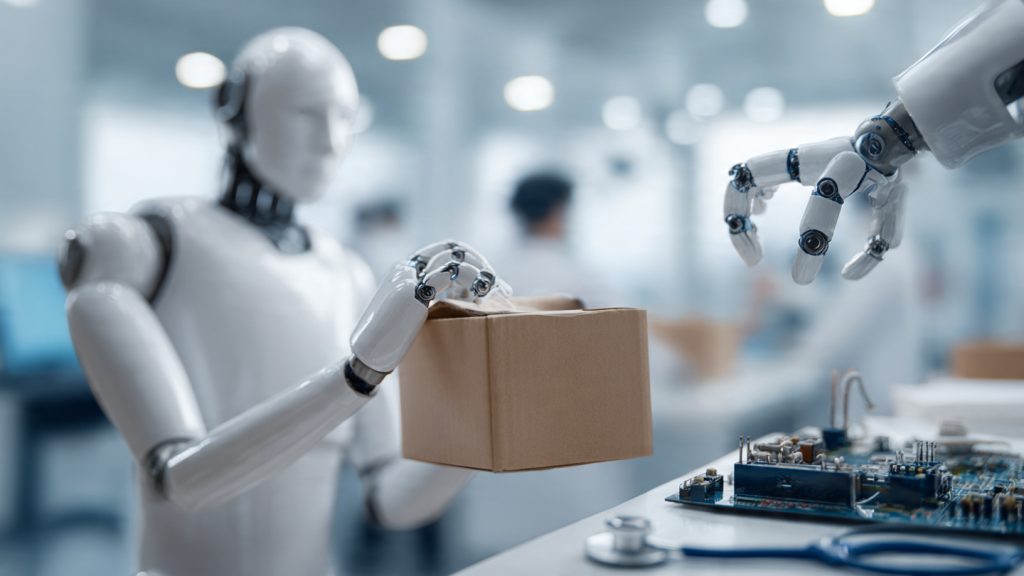
The idea of intelligent machines has captivated humans for centuries, appearing in ancient myths and early literature. But the journey from these fantastical concepts to tangible robots has been a fascinating one, accelerating dramatically in recent decades.
Contents
- 0.1 Early Concepts and Mechanical Marvels
- 0.2 The Industrial Revolution to Modern Manufacturing
- 0.3 Personal Robotics: Beyond the Factory Floor
- 0.4 Artificial Intelligence and Machine Learning: The Brains of the Operation
- 0.5 Sensor Technology and Perception: Seeing and Feeling the World
- 0.6 Advanced Actuators and Materials: Movement and Dexterity
- 0.7 Transforming Manufacturing and Logistics
- 0.8 Enhancing Healthcare and Medicine
- 0.9 Robotics in Space Exploration: Pushing the Boundaries of Human Achievement
- 0.10 The Future of Work: How Robotics is Changing the Job Landscape
- 0.11 Privacy and Security Concerns
- 0.12 The Question of Accountability and Responsibility
- 0.13 Overcoming Technical Hurdles
- 0.14 Cost and Accessibility
- 0.15 Public Perception and Trust
- 1 FAQs
- 1.1 1. What is the current state of robotics technology?
- 1.2 2. What are some ethical and social implications of robotics in the future?
- 1.3 3. How is artificial intelligence shaping the future of robotics?
- 1.4 4. What are some cutting-edge research and development areas in robotics?
- 1.5 5. How is robotics being integrated into healthcare and medicine?
Early Concepts and Mechanical Marvels
Long before silicon chips, people dreamed of automatons. Ancient Greek texts describe mechanical servants, and historical accounts mention intricate clockwork figures designed to mimic human or animal actions. These early “robots” were more about spectacle and demonstrating ingenious engineering than practical use, but they laid the conceptual groundwork for what was to come. Leonardo da Vinci even sketched designs for a mechanical man.
The Industrial Revolution to Modern Manufacturing
The real push for practical robotics came with the Industrial Revolution. Factories required repetitive tasks, and machines were gradually developed to automate these processes. The first industrial robot, Unimate, appeared in the 1960s, performing dangerous and monotonous tasks on assembly lines. This marked a significant shift: robots were no longer just curiosities but valuable tools for efficiency and safety. Today, industrial robots are the backbone of modern manufacturing, assembling cars, electronics, and countless other products with incredible precision and speed. They have transformed industries by increasing productivity and reducing human exposure to hazardous environments.
Personal Robotics: Beyond the Factory Floor
More recently, robotics has moved beyond the factory floor and into our homes and personal lives. Think about robotic vacuum cleaners that autonomously navigate your living room or lawnmowers that trim your grass with minimal intervention. These consumer-level robots, while often simplistic compared to industrial counterparts, represent a growing trend towards integrating robotic assistance into everyday chores and convenience. The development of more intuitive interfaces and lower costs is making these devices increasingly accessible.
The pace of innovation in robotics is staggering. Breakthroughs in various fields are converging to create machines that are more intelligent, adaptable, and capable than ever before.
Artificial Intelligence and Machine Learning: The Brains of the Operation
At the core of modern robotics advancements are artificial intelligence (AI) and machine learning (ML). These technologies are essentially giving robots the ability to “think” and “learn.” Instead of being programmed for every single scenario, AI-powered robots can analyze data, recognize patterns, and make decisions autonomously. This is crucial for tasks like object recognition, navigation in complex environments, and even learning new skills through trial and error, much like humans do. Deep learning, a subset of machine learning, has been particularly transformative, enabling robots to interpret sensory data, such as images and sounds, with unprecedented accuracy.
Sensor Technology and Perception: Seeing and Feeling the World
For robots to interact effectively with their environment, they need to perceive it accurately. Advances in sensor technology are providing robots with enhanced “senses.” Lidar (Light Detection and Ranging), cameras, ultrasonic sensors, and tactile sensors are allowing robots to map their surroundings, detect objects, understand their properties, and even “feel” pressure or texture. This improved perception is vital for tasks requiring delicate manipulation, obstacle avoidance, and safe interaction with humans. Imagine a robot surgeon performing a procedure with microscopic precision, guided by sophisticated visual and haptic feedback.
Advanced Actuators and Materials: Movement and Dexterity
The physical components of robots are also undergoing significant improvements. Advanced actuators (the components that make robots move) are becoming more powerful, precise, and energy-efficient. Engineers are also experimenting with new materials, including flexible and compliant materials, to create robots that are more adaptable, safer, and even resemble biological organisms. Soft robotics, for instance, focuses on building robots from intrinsically compliant materials, making them ideal for delicate tasks or interacting safely with humans. These innovations are leading to robots with greater dexterity and a wider range of motion, allowing them to perform more intricate tasks.
Robotics isn’t just a technological marvel; it’s a force reshaping industries and influencing our daily routines in profound ways.
Transforming Manufacturing and Logistics
Beyond traditional assembly lines, robotics is revolutionizing supply chains and logistics. Autonomous mobile robots (AMRs) are navigating warehouses, transporting goods, and optimizing inventory management. Drones are being used for delivery in remote areas and for inspecting infrastructure. This automation leads to increased efficiency, reduced labor costs, and faster delivery times, fundamentally altering how products are made, stored, and distributed. The entire process from raw material to consumer is becoming more streamlined and automated.
Enhancing Healthcare and Medicine
In healthcare, robotics is opening up new frontiers. Robotic surgical systems allow for minimally invasive procedures with enhanced precision, leading to faster recovery times for patients. Companion robots are being developed to assist the elderly or individuals with disabilities, providing monitoring, medication reminders, and even social interaction. Exoskeletons are helping people with mobility impairments regain movement. The diagnostic capabilities of robots are also expanding, with AI-powered systems assisting in identifying diseases from medical images with remarkable accuracy.
Robotics in Space Exploration: Pushing the Boundaries of Human Achievement
Robots are indispensable partners in space exploration, venturing into environments too hostile or distant for humans. Rovers like Curiosity and Perseverance have extensively explored Mars, collecting data and performing experiments that would be impossible for human astronauts. Robotic arms on space stations assist with maintenance and experiments. The next generation of space robots will play even greater roles in asteroid mining, constructing lunar bases, and even exploring other planetary bodies, paving the way for future human missions and expanding our understanding of the universe.
As robotics becomes more intertwined with society, it brings with it a complex set of ethical and social considerations that we need to actively address.
The Future of Work: How Robotics is Changing the Job Landscape
One of the most frequently discussed impacts of robotics is on the job market. While robots excel at repetitive and dangerous tasks, their increasing capabilities mean they can take on more complex roles. This will undoubtedly lead to job displacement in certain sectors, requiring individuals to adapt and acquire new skills. However, it also creates new jobs in robotics development, maintenance, and oversight. The key will be to focus on education and reskilling initiatives that prepare the workforce for a collaborative future with robots, rather than one of wholesale replacement. Rethinking education and lifelong learning will be critical.
Privacy and Security Concerns
As robots become more autonomous and connected, they will collect vast amounts of data about their environments and the people interacting with them. This raises significant privacy concerns. How will this data be stored, used, and protected? Ensuring the security of robotic systems is also paramount, as a hacked robot could pose serious risks, from intellectual property theft to physical harm. Developing robust cybersecurity measures and regulatory frameworks will be essential to mitigating these risks.
The Question of Accountability and Responsibility
When an autonomous robot makes a mistake or causes harm, who is responsible? Is it the robot’s programmer, the manufacturer, the owner, or the robot itself? These are difficult legal and ethical questions that society needs to grapple with. Establishing clear guidelines for accountability will be crucial as robots take on more decision-making roles in critical applications like self-driving cars or medical procedures.
Despite the rapid advancements, the field of robotics still faces significant challenges, but these challenges also present exciting opportunities for innovation.
Overcoming Technical Hurdles
Developing robots that can robustly operate in highly unstructured and dynamic environments remains a major technical hurdle. Human-level dexterity, common-sense reasoning, and seamless human-robot interaction are still areas of active research. Ensuring the reliability and safety of these complex systems under all operating conditions is a continuous engineering challenge.
Cost and Accessibility
While the cost of some robotic technologies is decreasing, sophisticated robots remain expensive, limiting their widespread adoption, especially for small businesses or individuals. Making robotics more affordable and accessible will be crucial for democratizing its benefits. This involves developing more modular and scalable robotic solutions, as well as fostering open-source robotics initiatives.
Public Perception and Trust
Public perception of robots is a crucial factor in their integration into society. Fear of job loss, concerns about “killer robots,” or a general distrust of autonomous systems can hinder adoption. Promoting education about robotics, showcasing its positive impacts, and ensuring transparency in development will be vital for building public trust and acceptance. Ultimately, addressing these challenges will unlock the full potential of robotics to improve our lives and push the boundaries of what’s possible.
FAQs
1. What is the current state of robotics technology?
Robotics technology has advanced significantly in recent years, with developments in artificial intelligence, machine learning, and sensor technology. Robots are now being used in a wide range of industries, from manufacturing and healthcare to space exploration and everyday consumer applications.
As robotics technology continues to advance, there are ethical and social implications to consider, such as the impact on employment, privacy concerns, and the potential for autonomous robots to make decisions that affect human lives. It is important to address these issues as the use of robotics becomes more widespread.
3. How is artificial intelligence shaping the future of robotics?
Artificial intelligence is playing a crucial role in shaping the future of robotics by enabling robots to learn from their experiences, make decisions, and adapt to new situations. This has led to the development of more autonomous and intelligent robots with a wide range of applications.
4. What are some cutting-edge research and development areas in robotics?
Cutting-edge research and development in robotics include advancements in soft robotics, swarm robotics, human-robot interaction, and bio-inspired robotics. These areas are pushing the boundaries of what robots can do and opening up new possibilities for their use in various industries.
5. How is robotics being integrated into healthcare and medicine?
Robotics is being integrated into healthcare and medicine in various ways, such as surgical robots for minimally invasive procedures, exoskeletons for rehabilitation, and telepresence robots for remote patient care. These advancements are improving patient outcomes and expanding the capabilities of healthcare professionals.

With over 5 years of experience in digital learning and productivity, we specialize in creating practical and easy-to-follow solutions.Our expertise focuses on simplifying complex concepts into clear, actionable strategies for everyday use.We are committed to helping learners and professionals improve efficiency, build skills, and achieve consistent growth.