
Demystifying 5G Technology: A Comprehensive Guide for Beginners
Ever wondered what all the fuss about 5G is? Simply put, 5G is the fifth generation of cellular technology, designed to deliver much faster speeds, lower latency (the delay before a transfer of data begins), and greater capacity than its predecessors. Think of it as a huge upgrade to how our devices connect to the internet, paving the way for innovations that were previously science fiction.
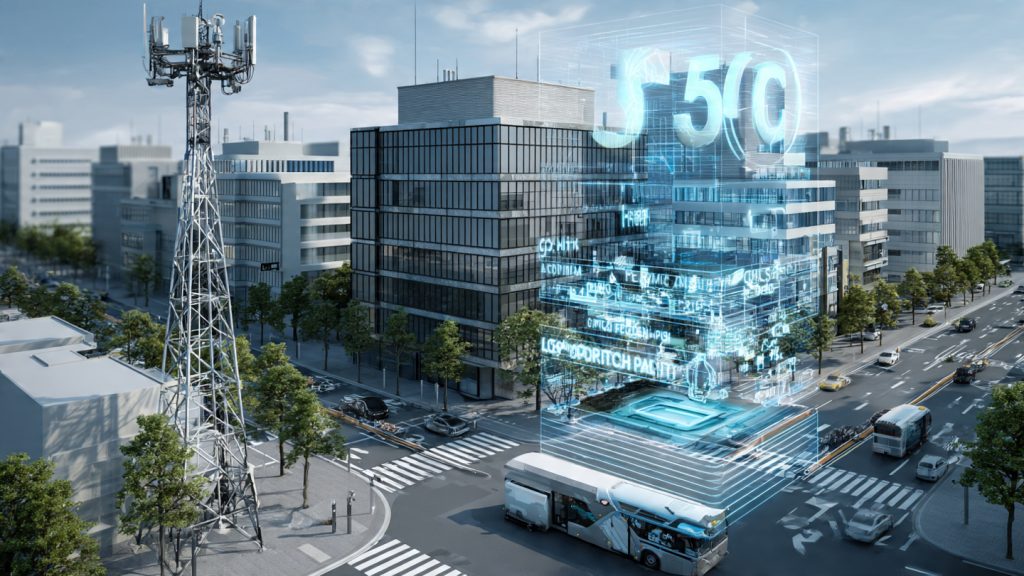
Let’s break down what 5G means for you and me. It’s not just about quicker downloads, though that’s a big part of it. 5G fundamentally changes how devices interact with networks and each other.
Contents
- 0.1 The Leap from 4G to 5G
- 0.2 Key Characteristics of 5G
- 0.3 The Role of Millimeter Wave, Mid-Band, and Low-Band Frequencies
- 0.4 Infrastructure: Small Cells and Massive MIMO
- 0.5 Network Slicing and Edge Computing
- 0.6 Transforming Mobile Devices and the Internet of Things
- 0.7 5G in Smart Cities and Autonomous Vehicles
- 0.8 Debunking Common Myths and Misconceptions About 5G
- 0.9 Potential Health Concerns and Safety Measures
- 0.10 The Revolutionizing Role of 5G in Industries
- 0.11 Global 5G Deployment: Challenges and Opportunities
- 0.12 Key Players and Innovations in the Industry
- 1 FAQs
- 1.1 What is 5G technology, and how does it work?
- 1.2 What are the potential impacts of 5G on mobile devices and the Internet of Things (IoT)?
- 1.3 What are some common myths and misconceptions about 5G technology?
- 1.4 What are the potential health concerns associated with 5G technology, and what safety measures are in place?
- 1.5 What are the challenges and opportunities in the deployment of 5G technology on a global scale?
The Leap from 4G to 5G
To truly grasp 5G, it helps to understand its lineage. We’ve come a long way from the analog voice calls of 1G. 2G introduced digital voice and basic data. 3G brought mobile internet and data services, while 4G ushered in the smartphone era with faster mobile broadband. Each generation has been about improving speed and capacity. 5G takes these improvements to a whole new level, pushing the boundaries of what’s possible with wireless technology. It allows for a massive increase in the number of devices that can connect simultaneously, something previous generations couldn’t handle.
Key Characteristics of 5G
Three main features define 5G: enhanced mobile broadband (eMBB), ultra-reliable low-latency communication (URLLC), and massive machine-type communications (mMTC). Enhanced Mobile Broadband is what you’ll notice first, with significantly faster download and upload speeds. This means streaming 4K video on the go without buffering or downloading large files in seconds. Ultra-Reliable Low-Latency Communication is crucial for applications where even a millisecond of delay matters, like autonomous vehicles or remote surgery. Finally, Massive Machine-Type Communications addresses the need to connect billions of IoT devices, from smart sensors in your home to industrial equipment, all at once. These aren’t just buzzwords; they represent a fundamental shift in how networks are designed and utilized.
Under the hood, 5G is quite a bit more complex than 4G, relying on several new technologies and a re-imagined network architecture.
The Role of Millimeter Wave, Mid-Band, and Low-Band Frequencies
5G doesn’t use just one type of radio frequency; it uses a range, each with its own pros and cons. Low-band 5G operates on frequencies similar to 4G, offering good coverage over wide areas but with speeds that aren’t dramatically faster than 4G. Mid-band 5G strikes a balance, providing a good mix of speed and coverage. This is where most early 5G deployments are happening. Millimeter wave (mmWave) 5G uses much higher frequencies, allowing for incredibly fast speeds and massive capacity but with a very limited range and difficulty penetrating obstacles like walls. Think of mmWave 5G as the super-fast option for dense urban areas or specific venues. To get a truly comprehensive 5G experience, networks need to deploy a combination of these frequency bands.
Infrastructure: Small Cells and Massive MIMO
To achieve its potential, 5G needs a different kind of infrastructure. Instead of relying solely on large, distant cell towers, 5G networks often utilize “small cells.” These are smaller, lower-power base stations that can be placed on lampposts, buildings, or even inside homes, bringing the network closer to users and improving coverage in dense areas. Another critical technology is massive MIMO (multiple-input, multiple-output). Essentially, Massive MIMO base stations have many more antennas than previous generations, allowing them to send and receive data from multiple users simultaneously and more efficiently, leading to higher capacity and better performance. This is like having many more Lanes on a highway, allowing for more traffic to flow smoothly.
Network Slicing and Edge Computing
These are two concepts that really differentiate 5G. Network slicing allows network operators to create virtual, isolated networks tailored for specific applications. For example, an autonomous vehicle might get a slice of the network dedicated to ultra-low latency, while smart home devices might get a slice optimized for massive connectivity. This customization ensures that different services get exactly what they need from the network. Edge computing involves bringing data processing and storage closer to the source of data generation, rather than sending everything to a distant central server. This further reduces latency and is essential for real-time applications, making decisions almost instantly without waiting for data to travel long distances.
5G isn’t just an upgrade for your phone; it’s a foundational technology that will reshape entire industries and how we live our lives.
Transforming Mobile Devices and the Internet of Things
For mobile devices, 5G means much more than just faster web browsing. It enables seamless cloud gaming, augmented reality (AR) and virtual reality (VR) experiences on the go, and the ability to download entire seasons of shows in minutes. But its impact on the Internet of Things (IoT) is arguably even greater. With its ability to connect millions of devices with low power consumption and reliable connectivity, 5G is the backbone for a truly interconnected world. Imagine smart cities where traffic lights adjust in real-time based on traffic flow, where everything from your coffee maker to your car is part of a seamlessly integrated network, communicating with each other and the cloud.
5G in Smart Cities and Autonomous Vehicles
Smart cities are a prime example of 5G’s transformative power. With 5G, cities can deploy vast networks of sensors to monitor everything from air quality and waste management to public safety and infrastructure integrity. This real-time data allows for more efficient urban planning, better resource allocation, and a higher quality of life for residents. Autonomous vehicles are another area that will be profoundly impacted. For self-driving cars to operate safely and effectively, they need near-instantaneous communication with each other, with traffic infrastructure, and with cloud-based services. 5G’s ultra-low latency and high reliability are absolutely critical for this. A split-second delay could have dire consequences, making 5G an essential enabler for widespread autonomous transport.
Like any new technology, 5G comes with its share of questions, concerns, and opportunities.
Debunking Common Myths and Misconceptions About 5G
There’s a lot of information and misinformation floating around about 5G. One common myth is that 5G causes health problems. While the higher frequencies used by mmWave 5G are new to consumer wireless, the scientific consensus, based on extensive research, is that 5G radio waves are non-ionizing, meaning they don’t have enough energy to damage DNA and are not a significant health risk. Reputable health organizations worldwide, like the World Health Organization, continue to monitor and research, but current evidence does not support claims of harm. Another misconception is that 5G is exclusively for high speeds. As discussed, it’s also about capacity and low latency, enabling a wide range of new applications beyond just faster downloads.
Potential Health Concerns and Safety Measures
It’s natural to have questions about the safety of new technologies, especially those that involve wireless signals. Regulatory bodies like the FCC in the United States and similar organizations globally set strict limits on RF (radiofrequency) exposure from cellular networks. These limits are based on decades of scientific research and are designed to protect public health. 5G technology operates within these established safety guidelines. As 5G networks become more widespread, monitoring and continued research are ongoing to ensure that these standards remain appropriate.
The Revolutionizing Role of 5G in Industries
Beyond personal use, 5G is poised to revolutionize industries across the board. In manufacturing, it enables “smart factories” with connected robots, real-time inventory management, and predictive maintenance. For healthcare, 5G can facilitate remote surgery, advanced telemedicine, and wearable devices that monitor health with unprecedented accuracy. Agriculture can leverage 5G for precision farming, using sensors and drones to optimize crop yields and manage resources more efficiently. Logistics and transportation will see improved fleet management, real-time tracking, and automated port operations. The low latency and high capacity of 5G are key to unlocking these advanced applications, driving efficiency, and creating new business models.
Understanding who the key players are and what challenges lie ahead is important for grasping the full picture of 5G.
Global 5G Deployment: Challenges and Opportunities
Deploying 5G globally is a massive undertaking. One of the main challenges is the sheer cost of building out the new infrastructure, especially for mmWave 5G, which requires many more small cells. Spectrum allocation, the process of assigning specific radio frequencies for 5G use, is another complex hurdle for governments and regulators worldwide. Cybersecurity is also a constant concern, as a more interconnected world presents more potential points of vulnerability. Despite these challenges, the opportunities presented by 5G are immense. It promises to drive economic growth, foster innovation, and bridge the digital divide by bringing high-speed connectivity to underserved areas. Countries that successfully deploy robust 5G networks stand to gain a significant competitive advantage.
Key Players and Innovations in the Industry
The 5G ecosystem involves a vast array of companies. Network equipment providers like Ericsson, Huawei, and Nokia are at the forefront, developing the hardware and software that build the core of 5G networks. Chipmakers like Qualcomm and MediaTek are crucial for enabling 5G connectivity in smartphones and other devices. Mobile operators such as AT&T, Verizon, T-Mobile, Vodafone, and many others worldwide are responsible for rolling out and managing these networks. Beyond these, a myriad of companies are innovating on top of 5G, developing applications and services that leverage its unique capabilities, from augmented reality startups to industrial IoT solution providers. This collaborative environment is driving rapid advancements and ensuring that 5G’s potential is fully realized.
FAQs
What is 5G technology, and how does it work?
5G technology is the fifth generation of wireless communication technology, designed to provide faster and more reliable internet connectivity. It operates on higher frequency bands and utilizes advanced antenna technologies to transmit and receive data at a much faster rate than its predecessors.
What are the potential impacts of 5G on mobile devices and the Internet of Things (IoT)?
5G technology is expected to significantly enhance the performance of mobile devices and enable seamless connectivity for IoT devices. It will support a larger number of connected devices, reduce latency, and enable new applications and services in areas such as smart homes, smart cities, and industrial automation.
What are some common myths and misconceptions about 5G technology?
Some common myths and misconceptions about 5G technology include concerns about health risks, conspiracy theories about its impact on the environment, and misinformation about its capabilities and limitations. It is important to rely on credible sources and scientific evidence when evaluating the impact of 5G technology.
What are the potential health concerns associated with 5G technology, and what safety measures are in place?
There have been concerns raised about the potential health effects of exposure to electromagnetic radiation from 5G technology. However, regulatory agencies and health organizations have conducted extensive research and have established safety guidelines to ensure that 5G technology meets safety standards and does not pose significant health risks.
What are the challenges and opportunities in the deployment of 5G technology on a global scale?
The deployment of 5G technology presents challenges such as infrastructure investment, spectrum allocation, and regulatory hurdles. However, it also offers opportunities for economic growth, innovation, and improved connectivity, especially in underserved areas. Collaboration between industry stakeholders and government entities is crucial for successful global deployment of 5G technology.

With over 5 years of experience in digital learning and productivity, we specialize in creating practical and easy-to-follow solutions.Our expertise focuses on simplifying complex concepts into clear, actionable strategies for everyday use.We are committed to helping learners and professionals improve efficiency, build skills, and achieve consistent growth.