AI in Action: How Artificial Intelligence is Changing the Way We Live and work.
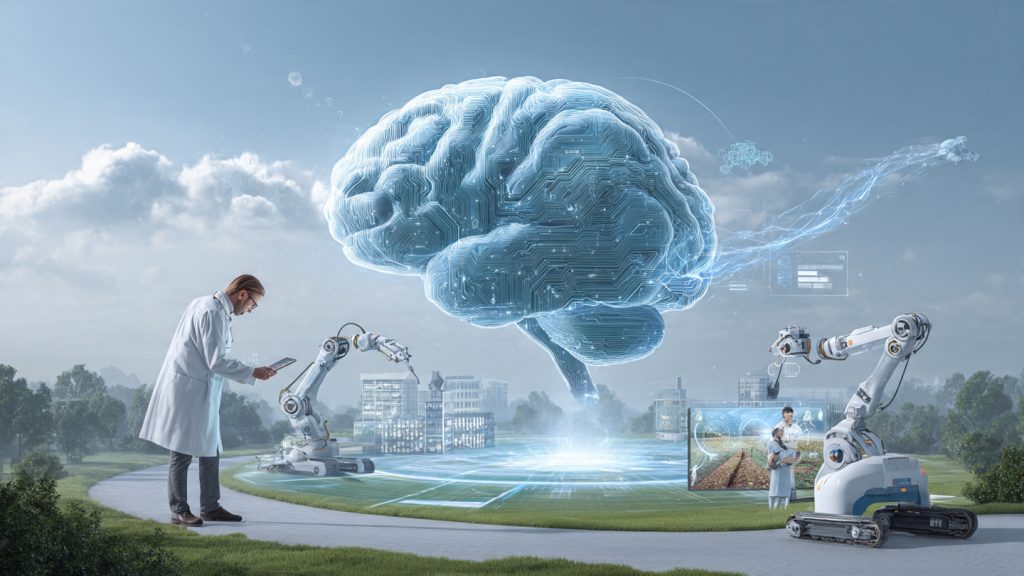
Artificial intelligence (AI) is no longer just a concept from sci-fi movies; it’s actively reshaping our daily lives and how we get things done. From the way we manage our health to how we entertain ourselves, AI is quietly, and sometimes not so quietly, making its mark. It’s about machines learning and making decisions in ways that mimic human intelligence, and the applications are vast and growing by the day.
The impact of AI on healthcare is truly profound, moving beyond theoretical discussions to tangible improvements in patient care. One of the most significant areas is in diagnostic imaging.
Contents
- 0.1 Smarter Diagnosis, Faster Results
- 0.2 Personalized Treatment Plans
- 0.3 Drug Discovery Accelerates
- 0.4 Enhanced Fraud Detection and Security
- 0.5 Personalized Financial Advice and Robo-Advisors
- 0.6 Algorithmic Trading Gets Smarter
- 0.7 Increased Safety on the Roads
- 0.8 Improved Traffic Flow and Efficiency
- 0.9 New Mobility Services
- 0.10 Smarter Chatbots and Virtual Assistants
- 0.11 Predictive Customer Needs
- 0.12 Sentiment Analysis for Better Experiences
- 0.13 Personalized Learning Paths
- 0.14 Adaptive Tutoring Systems
- 0.15 Automating Administrative Tasks
- 0.16 Predictive Maintenance for Reduced Downtime
- 0.17 Enhanced Quality Control and Defect Detection
- 0.18 Optimizing Production Processes
- 0.19 Precision Farming and Resource Management
- 0.20 Crop Yield Prediction and Disease Monitoring
- 0.21 Autonomous Agricultural Machinery
- 0.22 Personalized Content Recommendations
- 0.23 AI-Generated Content and Creative Tools
- 0.24 Enhancing Gaming and Virtual Worlds
- 0.25 Advanced Threat Detection and Response
- 0.26 Proactive Vulnerability Assessment
- 0.27 Automating Security Operations
- 0.28 Streamlining Recruitment Processes
- 0.29 Enhancing Employee Engagement and Retention
- 0.30 Personalized Training and Development
- 1 FAQs
- 1.1 What is artificial intelligence (AI) and how is it changing the way we live and work?
- 1.2 How is AI revolutionizing diagnosis and treatment in healthcare?
- 1.3 How is AI transforming the future of banking and investment in finance?
- 1.4 What is the impact of autonomous vehicles on transportation?
- 1.5 How is AI enhancing the user experience in customer service?
Smarter Diagnosis, Faster Results
Radiologists spend countless hours reviewing X-rays, CT scans, and MRIs. AI algorithms can now analyze these images with remarkable speed and accuracy, often identifying subtle anomalies that might be missed by the human eye. This means conditions like certain cancers or diabetic retinopathy can be detected earlier, leading to better outcomes for patients. It’s not about replacing doctors but providing them with powerful tools to enhance their diagnostic capabilities, acting as an incredibly sophisticated second opinion.
Personalized Treatment Plans
Beyond diagnosis, AI is also revolutionizing treatment. By analyzing vast datasets of patient information, including genetic profiles, medical history, and responses to previous treatments, AI can help create highly personalized treatment plans. This is particularly impactful in areas like oncology, where tailoring chemotherapy or radiation based on an individual’s specific tumor characteristics can significantly improve effectiveness and reduce side effects.
Drug Discovery Accelerates
The process of developing new drugs is notoriously long and expensive. AI is accelerating this by identifying potential drug candidates and predicting their efficacy and safety much faster than traditional methods. This could lead to quicker breakthroughs for diseases we currently have limited treatment options for.
The financial world, with its reliance on complex data and intricate algorithms, is a natural fit for AI. It’s streamlining operations, improving security, and offering new ways for individuals and institutions to manage their money.
Enhanced Fraud Detection and Security
Banks and financial institutions are constantly combating fraud. AI-powered systems can analyze transaction patterns in real-time, flagging suspicious activity with a level of detail and speed that’s impossible for human agents alone. This not only protects customers’ accounts but also safeguards the integrity of the entire financial system.
Personalized Financial Advice and Robo-Advisors
For individual investors, AI is democratizing access to financial advice. Robo-advisors, powered by AI, can assess an individual’s financial goals, risk tolerance, and time horizon to create and manage diversified investment portfolios. This offers a more accessible and often more cost-effective alternative to traditional human financial advisors, particularly for those with smaller investment portfolios.
Algorithmic Trading Gets Smarter
In the world of investment banking, AI is driving algorithmic trading. These sophisticated algorithms can analyze market data in milliseconds, identifying trading opportunities and executing trades at speeds that humans simply cannot match. This leads to more efficient markets but also raises questions about market volatility and the role of human oversight.
Perhaps one of the most visible applications of AI is in the development of autonomous vehicles (AVs). This technology promises to transform how we travel, potentially making our roads safer and more efficient.
Increased Safety on the Roads
The vast majority of traffic accidents are caused by human error. Autonomous vehicles, with their advanced sensor systems, AI-powered decision-making, and constant vigilance, have the potential to significantly reduce accidents. They don’t get distracted or tired and don’t drive under the influence.
Improved Traffic Flow and Efficiency
Beyond safety, AVs could revolutionize traffic flow. By communicating with each other and with traffic infrastructure, autonomous vehicles can optimize speed, braking, and routing to reduce congestion and travel times. Imagine a world where traffic jams are a thing of the past, thanks to interconnected, intelligently driven vehicles.
New Mobility Services
The advent of AVs is also paving the way for new mobility services. Ride-sharing could become even more seamless, with entire fleets of autonomous cars operating on demand. This could also provide greater independence and mobility for individuals who are unable to drive, such as the elderly or those with disabilities.
Customer service has always been a crucial aspect of business, and AI is elevating it to new heights, not just through chatbots but through a more integrated approach to understanding and assisting customers.
Smarter Chatbots and Virtual Assistants
While early chatbots could feel clunky and limited, modern AI-powered virtual assistants are far more sophisticated. They can understand natural language, learn from interactions, and provide increasingly helpful and personalized responses to customer queries. This frees up human agents to handle more complex issues.
Predictive Customer Needs
AI can analyze customer behavior and purchase history to anticipate their needs before they even arise. This allows businesses to proactively offer relevant products or services, provide timely support, or even identify potential issues before they become problems for the customer.
Sentiment Analysis for Better Experiences
Understanding how customers feel is vital. AI can analyze customer feedback from reviews, social media, and support interactions to gauge sentiment. This allows companies to identify areas where they are excelling and areas where improvements are needed, leading to a better overall customer experience.
The traditional one-size-fits-all approach to education is starting to give way to more personalized methods, and AI is at the forefront of this transformation.
Personalized Learning Paths
Every student learns differently and at their own pace. AI can analyze a student’s performance, learning style, and engagement levels to create individualized learning paths. This means providing more challenging material for advanced students and offering additional support for those who are struggling, all within the same classroom.
Adaptive Tutoring Systems
Imagine a tutor that’s available 24/7, understands your specific difficulties, and explains concepts in a way that resonates with you. AI-powered adaptive tutoring systems can do just that, providing targeted feedback and exercises to help students master difficult concepts.
Automating Administrative Tasks
Teachers often spend a significant amount of time on administrative tasks like grading and scheduling. AI can automate many of these, freeing up educators to focus more on teaching and interacting with students.
Manufacturing has been a constant evolution, and AI is ushering in the era of the “smart factory,” where efficiency, quality, and adaptability are paramount.
Predictive Maintenance for Reduced Downtime
One of the biggest headaches in manufacturing is unexpected equipment failure, which can bring production to a halt. AI can analyze sensor data from machinery to predict when a component is likely to fail, allowing for proactive maintenance. This significantly reduces downtime and costly repairs.
Enhanced Quality Control and Defect Detection
Ensuring product quality is crucial. AI systems, particularly computer vision, can inspect manufactured goods with incredible precision, identifying even minute defects that might be missed by human inspectors. This leads to higher quality products and less waste.
Optimizing Production Processes
AI can analyze vast amounts of data from the entire production line to identify bottlenecks, inefficiencies, and areas for improvement. This allows for real-time adjustments to optimize production schedules, resource allocation, and overall output.
Feeding a growing global population sustainably is a major challenge, and AI is offering innovative solutions for the agricultural sector.
Precision Farming and Resource Management
AI-powered sensors and drones can collect detailed data on soil conditions, weather patterns, and crop health across large fields. This information allows farmers to apply water, fertilizers, and pesticides only where and when they are needed, optimizing resource use and minimizing environmental impact.
Crop Yield Prediction and Disease Monitoring
By analyzing historical data, weather forecasts, and real-time crop conditions, AI can predict crop yields with greater accuracy. It can also help detect early signs of disease or pest infestations, allowing farmers to intervene quickly and prevent widespread crop damage.
Autonomous Agricultural Machinery
Self-driving tractors and harvesting robots are becoming a reality, thanks to AI. These autonomous machines can perform tasks with precision and efficiency, often operating around the clock, which can be particularly beneficial in areas with labor shortages.
The entertainment industry, always pushing the boundaries of creativity, is finding new avenues of innovation with the help of AI, from content creation to personalized recommendations.
Personalized Content Recommendations
Streaming services are a prime example of AI in action. AI algorithms analyze your viewing habits, preferences, and even the time of day you watch to recommend movies and TV shows you’re likely to enjoy. This creates a more curated and engaging viewing experience.
AI-Generated Content and Creative Tools
AI is increasingly being used as a tool for content creation, from generating music and artwork to assisting in scriptwriting. While still in its early stages for complex narratives, AI can help artists overcome creative blocks and explore new artistic possibilities.
Enhancing Gaming and Virtual Worlds
In video games, AI powers non-player characters (NPCs), making them more realistic and dynamic. It’s also used to generate game environments and personalize challenges, creating more immersive and engaging gameplay experiences that adapt to the player.
As technology advances, so do the threats it faces. AI is becoming an indispensable tool in the constant battle to protect our digital lives.
Advanced Threat Detection and Response
Cybercriminals are constantly developing new and sophisticated attack methods. AI can analyze network traffic patterns and system behavior at an unprecedented scale to detect anomalies and identify threats in real-time, often before they can cause significant damage.
Proactive Vulnerability Assessment
AI can be used to scan systems and networks for potential vulnerabilities, helping organizations identify and patch weaknesses before they can be exploited by attackers. This proactive approach is crucial in a rapidly changing threat landscape.
Automating Security Operations
Many cybersecurity tasks can be repetitive and time-consuming. AI can automate many of these, such as incident response and security patching, allowing human security professionals to focus on more strategic and complex challenges.
Even the traditionally human-centric field of HR is being transformed by AI, improving efficiency and creating more informed decision-making processes.
Streamlining Recruitment Processes
AI-powered tools can sift through thousands of resumes much faster than humans, identifying candidates whose skills and experience best match job requirements. This can significantly speed up the initial stages of recruitment and reduce bias.
Enhancing Employee Engagement and Retention
AI can analyze employee data, such as feedback, performance metrics, and even anonymized sentiment from internal communications, to identify potential issues that might lead to disengagement or turnover. HR teams can then proactively address these concerns.
Personalized Training and Development
AI can help identify skill gaps within a workforce and recommend personalized training programs for employees. This ensures that individuals are developing the skills needed for their current roles and for future career advancement, benefiting both the employee and the organization.
FAQs
What is artificial intelligence (AI) and how is it changing the way we live and work?
Artificial intelligence (AI) refers to the simulation of human intelligence in machines that are programmed to think and act like humans. AI is changing the way we live and work by automating repetitive tasks, analyzing large amounts of data to make predictions, and improving decision-making processes across various industries.
How is AI revolutionizing diagnosis and treatment in healthcare?
AI is revolutionizing diagnosis and treatment in healthcare by analyzing medical images, predicting patient outcomes, and personalizing treatment plans. AI-powered tools can help healthcare professionals make more accurate diagnoses and provide more effective treatments for patients.
How is AI transforming the future of banking and investment in finance?
AI is transforming the future of banking and investment in finance by automating routine tasks, detecting fraudulent activities, and providing personalized financial advice. AI technologies are also used to analyze market trends and make investment decisions, leading to more efficient and profitable financial services.
What is the impact of autonomous vehicles on transportation?
Autonomous vehicles, powered by AI technology, are impacting transportation by improving road safety, reducing traffic congestion, and providing more efficient and convenient mobility options. AI enables autonomous vehicles to perceive their environment, make decisions, and navigate without human intervention.
How is AI enhancing the user experience in customer service?
AI is enhancing the user experience in customer service by providing personalized recommendations, automating customer interactions through chatbots, and analyzing customer feedback to improve products and services. AI technologies are also used to streamline customer support processes and resolve issues more efficiently.

With over 5 years of experience in digital learning and productivity, we specialize in creating practical and easy-to-follow solutions.Our expertise focuses on simplifying complex concepts into clear, actionable strategies for everyday use.We are committed to helping learners and professionals improve efficiency, build skills, and achieve consistent growth.