From Virtual Reality to AI: The Future of Tech in Education
The future of tech in education is a pretty exciting place, and at its forefront are virtual reality (VR) and artificial intelligence (AI). These aren’t just buzzwords for the tech industry; they’re rapidly reshaping how we teach and how students learn, moving from theoretical possibilities to practical applications that are actually transforming the classroom experience. In short, VR and AI are poised to make learning more engaging, personalized, and effective than ever before.
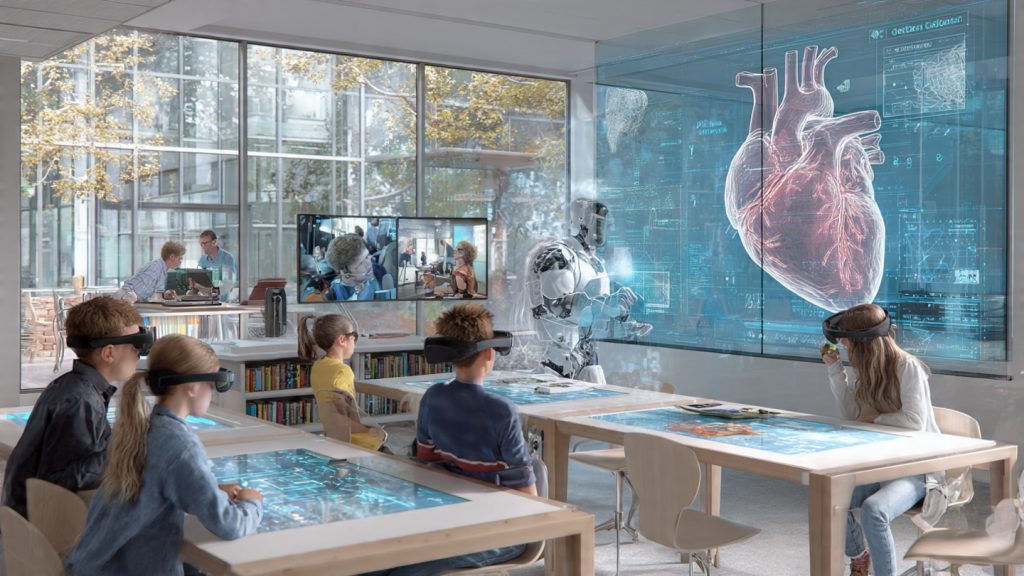
Virtual reality has the potential to completely change what it means to “be in” a classroom. Instead of just reading about ancient Rome, students could walk through its streets, visit the Colosseum, and get a real sense of its scale and grandeur. This isn’t about putting on a headset for fun; it’s about creating deeply immersive experiences that foster understanding and retention in ways traditional methods struggle to achieve.
Contents
- 0.1 Stepping into History and Science
- 0.2 Hands-On Learning Without the Mess
- 0.3 Developing Empathy Through Experience
- 0.4 Personalized Learning Paths
- 0.5 Intelligent Tutoring Systems
- 0.6 Streamlining Teacher Workloads
- 0.7 Adaptive Immersive Environments
- 0.8 AI-Guided VR Exploration
- 0.9 Data-Driven Insights for Educators
- 0.10 Reimagining Assessment
- 0.11 Fostering Collaboration in Virtual Spaces
- 0.12 Bridging the Gap Between Theory and Practice
- 0.13 Gamified Learning
- 0.14 Increased Motivation and Curiosity
- 0.15 Reduced Learner Anxiety
- 0.16 Teacher Training and Professional Development
- 0.17 Curriculum Design and Alignment
- 0.18 Piloting and Iteration
- 0.19 Cost and Accessibility
- 0.20 Technical Infrastructure and Support
- 0.21 Content Development and Quality
- 0.22 Teacher Buy-in and Resistance to Change
- 0.23 Individualized Pace and Progression
- 0.24 Tailored Content Delivery
- 0.25 Targeted Interventions and Support
- 0.26 Data Privacy and Security
- 0.27 Algorithmic Bias
- 0.28 Digital Divide and Equity
- 0.29 Over-reliance and Human Interaction
- 1 FAQs
- 1.1 What is virtual reality (VR) and artificial intelligence (AI) in education?
- 1.2 How are VR and AI transforming the classroom experience?
- 1.3 What are the applications of VR and AI in education?
- 1.4 What are the challenges in implementing VR and AI in education?
- 1.5 What are the ethical considerations in the use of VR and AI in education?
Stepping into History and Science
Imagine a biology class where students can shrink down and explore the human circulatory system, or a history lesson where they stand on the deck of a ship during a pivotal moment in exploration. VR allows for this kind of experiential learning, making abstract concepts tangible and memorable. It’s a powerful tool for visual learners, but its impact extends far beyond that, engaging multiple senses and creating a more holistic learning environment.
Hands-On Learning Without the Mess
Many subjects, especially in STEM fields, require hands-on experience. However, conducting certain experiments can be costly, time-consuming, or even dangerous. VR offers a safe and accessible alternative. Students can practice dissections, operate complex machinery, or even conduct chemistry experiments without any risk or waste. This democratizes access to critical learning experiences, allowing students from all backgrounds to participate fully.
Developing Empathy Through Experience
Beyond academic subjects, VR can also be a potent tool for developing social-emotional skills. By stepping into the shoes of someone else, perhaps a refugee fleeing their home or someone dealing with a specific disability, students can gain a deeper understanding and empathy for different perspectives and life experiences. This kind of visceral understanding is difficult to cultivate through reading or discussion alone.
While VR offers a new dimension of experience, AI is revolutionizing the backend of education, making it smarter, more efficient, and more personalized. AI isn’t here to replace teachers; it’s here to empower them and to give every student the individualized attention they need to thrive.
Personalized Learning Paths
One of AI’s most significant contributions is its ability to tailor learning experiences to each student’s unique needs and pace. AI algorithms can analyze a student’s performance, identify areas where they struggle, and then provide targeted resources or adjust the difficulty of the material. This means no student is left behind, and no student is held back from progressing at their optimal speed.
Intelligent Tutoring Systems
Think of AI as a tireless, ever-present tutor. AI-powered tutoring systems can provide instant feedback on assignments, explain complex concepts in different ways, and even predict when a student might be about to face a challenge. This constant support system can significantly boost a student’s confidence and mastery of the subject matter.
Streamlining Teacher Workloads
Teachers are often burdened with administrative tasks like grading, lesson planning, and reporting. AI can automate many of these time-consuming duties, freeing up teachers to focus on what they do best: engaging with students, fostering critical thinking, and providing mentorship. This has a ripple effect, improving the overall quality of instruction.
The combination of VR and AI creates a truly powerful synergy, allowing for learning experiences that are not only immersive but also incredibly intelligent and responsive. This is where the future of education really starts to take shape.
Adaptive Immersive Environments
Imagine a VR experience that dynamically adjusts based on your performance. If you’re struggling with a particular concept in a virtual lab, the AI could subtly change the parameters of the experiment or offer additional guidance within the VR environment itself. This creates a fluid and highly effective learning loop, where the technology actively supports the learner’s progression.
AI-Guided VR Exploration
AI can act as a guide within VR simulations. It can point out important details, answer student questions contextually, and even prompt further investigation based on the student’s expressed interests or demonstrated knowledge gaps. This ensures that VR experiences are not just passive viewing but active, guided exploration that maximizes learning outcomes.
Data-Driven Insights for Educators
AI can collect and analyze vast amounts of data on student interactions within VR. This data can provide educators with unprecedented insights into how students learn, what concepts are most challenging, and which teaching methods are most effective. This information can then be used to refine curriculum and teaching strategies, leading to continuous improvement in educational delivery.
The integration of VR and AI marks a significant shift, moving education away from a one-size-fits-all model towards a highly personalized, experiential, and engaging paradigm. This isn’t a distant future; it’s a transition that is already underway, and its implications are profound.
Reimagining Assessment
Traditional assessments often fail to capture the full spectrum of a student’s abilities. VR and AI can revolutionize assessment by allowing for performance-based evaluation within realistic simulations. AI can then analyze these complex performance data points, providing a more nuanced and accurate picture of a student’s understanding and skills, such as problem-solving or critical thinking in action.
Fostering Collaboration in Virtual Spaces
VR can create shared virtual spaces where students can collaborate on projects, even if they are geographically dispersed. AI can facilitate this collaboration by managing group dynamics, providing prompts for discussion, and ensuring that all participants are contributing effectively. This prepares students for the increasingly collaborative nature of the modern workforce.
Bridging the Gap Between Theory and Practice
One of the biggest challenges in education is helping students connect theoretical knowledge with practical application. VR and AI excel here. Students can learn theoretical principles and then immediately apply them in a simulated environment, receiving instant feedback from AI. This direct application solidifies understanding and makes learning more relevant.
When learning becomes an adventure rather than a chore, engagement soars. VR brings a level of interactivity and excitement that naturally captures students’ attention, while AI ensures that this engagement is directed towards meaningful learning outcomes.
Gamified Learning
The immersive nature of VR lends itself perfectly to gamified learning experiences. AI can further enhance this by tailoring game mechanics and challenges to individual student progress, ensuring that the “game” remains motivating and appropriately challenging, preventing boredom or frustration.
Increased Motivation and Curiosity
By presenting information in dynamic, interactive ways, VR and AI can spark a student’s natural curiosity. When students are actively involved in exploring and discovering, their motivation to learn increases significantly. The ability to “do” rather than just “read” is a powerful driver.
Reduced Learner Anxiety
For students who experience anxiety around traditional classroom settings or assessments, VR and AI can provide a less intimidating learning environment. AI can offer support and scaffolding, while the controlled environment of VR can reduce the pressure associated with making mistakes. This can lead to a more positive and productive learning experience for a wider range of students.
Making VR and AI a real part of education isn’t just about buying new gadgets; it’s about thoughtful integration that aligns with learning objectives.
Teacher Training and Professional Development
Equipping educators with the skills and confidence to effectively use VR and AI tools is crucial. Professional development programs need to focus on pedagogical approaches for these technologies, not just the technical aspects. Teachers need to understand how to leverage VR and AI to enhance learning, not just how to turn them on.
Curriculum Design and Alignment
New curriculum materials will need to be developed, or existing ones adapted, to take full advantage of VR and AI capabilities. This involves identifying where immersive experiences and AI-driven support can add the most value to specific learning objectives, ensuring that these technologies are not just add-ons but integral components of the learning journey.
Piloting and Iteration
Introducing new technologies into educational settings often requires a pilot phase. This allows schools to test different VR applications and AI tools, gather feedback from students and teachers, and make necessary adjustments before a wider rollout. This iterative process is key to successful implementation.
While the potential is vast, adopting VR and AI in education comes with its own set of hurdles that need to be addressed proactively.
Cost and Accessibility
The initial investment in VR hardware and AI software can be significant, posing a barrier for many educational institutions, especially those with limited budgets. Ensuring equitable access for all students, regardless of socioeconomic background, is a critical concern. Solutions might involve shared resource models or partnerships.
Technical Infrastructure and Support
Integrating these technologies requires robust internet connectivity, adequate computing power, and reliable technical support. Schools need to invest in their infrastructure and ensure they have the necessary IT personnel to manage and maintain the systems, troubleshooting issues as they arise.
Content Development and Quality
While there’s a growing amount of VR and AI educational content, ensuring its quality, accuracy, and pedagogical soundness remains a challenge. Developing high-quality, curriculum-aligned content takes time, expertise, and significant resources. Curation and vetting of existing content are also essential.
Teacher Buy-in and Resistance to Change
Some educators may be hesitant to adopt new technologies, due to a lack of training, confidence, or a concern about the impact on their teaching roles. Overcoming this requires open communication, comprehensive training, and demonstrating the clear benefits these tools can bring to both teachers and students, rather than seeing them as a replacement.
Personalized learning is perhaps the most significant promise of VR and AI in education. These technologies allow for a level of individualization that was previously unimaginable.
Individualized Pace and Progression
AI can monitor each student’s progress in real-time, identifying where they excel and where they need more support. VR experiences can then be adapted to match this pace, ensuring that students are always challenged but not overwhelmed. This fosters a sense of accomplishment and reduces frustration.
Tailored Content Delivery
AI can understand a student’s preferred learning style through their interactions and then recommend or deliver content in the most effective format for them. This might mean offering visual explanations in VR, audio explanations, or text-based resources, all guided by AI.
Targeted Interventions and Support
When AI identifies a student struggling with a particular concept, it can trigger immediate interventions. This might involve an AI-powered tutor offering extra practice, or a VR simulation designed to reinforce the challenging area in a more engaging way. This proactive support can prevent students from falling behind.
As these powerful technologies become more integrated, it’s important to address the ethical implications to ensure responsible and beneficial implementation.
Data Privacy and Security
AI systems in education collect a significant amount of student data. Protecting this data from breaches and misuse is paramount. Clear policies and robust security measures are essential to maintain trust and comply with privacy regulations. Parents need to be assured their children’s data is safe.
Algorithmic Bias
AI algorithms can inadvertently perpetuate existing biases if the data they are trained on is not representative. This could lead to unfair recommendations or assessments for certain groups of students. Ongoing monitoring and efforts to create diverse and unbiased datasets are critical.
Digital Divide and Equity
As discussed, the cost and accessibility of VR and AI technologies can exacerbate existing inequalities. Ensuring that these innovations benefit all students, not just those in well-resourced schools, requires deliberate planning and investment in equitable access.
Over-reliance and Human Interaction
While VR and AI offer incredible advantages, it’s crucial to maintain a balance with essential human interaction. Teachers play a vital role in mentorship, emotional support, and fostering social skills. The goal is to augment, not replace, the invaluable human element of education. The development of critical thinking and interpersonal skills still relies heavily on human guidance.
FAQs
What is virtual reality (VR) and artificial intelligence (AI) in education?
Virtual reality (VR) refers to a computer-generated simulation of an environment that can be interacted with in a seemingly real or physical way. Artificial intelligence (AI) involves the development of computer systems that can perform tasks that typically require human intelligence, such as visual perception, speech recognition, decision-making, and language translation. In education, VR and AI are being used to create immersive and personalized learning experiences for students.
How are VR and AI transforming the classroom experience?
VR and AI are transforming the classroom experience by providing students with interactive and engaging learning opportunities. VR allows students to explore virtual environments and simulations, while AI can personalize learning experiences based on individual student needs. These technologies also enable educators to track student progress and provide targeted support.
What are the applications of VR and AI in education?
The applications of VR and AI in education are diverse and include virtual field trips, interactive simulations, personalized learning platforms, intelligent tutoring systems, and adaptive learning technologies. These applications aim to enhance student engagement, improve learning outcomes, and provide educators with valuable insights into student performance.
What are the challenges in implementing VR and AI in education?
Challenges in implementing VR and AI in education include the cost of technology, access to necessary hardware and software, teacher training and professional development, concerns about data privacy and security, and the need to ensure equitable access to these technologies for all students. Additionally, there may be resistance to change and a lack of understanding about how to effectively integrate VR and AI into the curriculum.
What are the ethical considerations in the use of VR and AI in education?
Ethical considerations in the use of VR and AI in education include issues related to data privacy, student safety, algorithmic bias, and the potential for technology to replace human interaction and empathy in the learning process. Educators and policymakers must consider these ethical implications and develop guidelines for the responsible and equitable use of VR and AI in educational settings.

With over 5 years of experience in digital learning and productivity, we specialize in creating practical and easy-to-follow solutions.Our expertise focuses on simplifying complex concepts into clear, actionable strategies for everyday use.We are committed to helping learners and professionals improve efficiency, build skills, and achieve consistent growth.